Trumpeter
1/350 HMS Royal Oak (08)
|
Reviewed February 2026 |
Trumpeter
1/350 HMS Royal Oak (08)
|
Reviewed February 2026 |
| HISTORY | |||||||||||||||||||||||||
|
HMS Royal Oak was the third of five ships in the Revenge class of Royal Navy Battleships. The eighth warship to bear the name, Royal Oak was commissioned in 1916 and saw action at the Battle of Jutland where she scored hits on three of the German High Seas Fleet. Although modernized in the 1930's, by the start of the Second World War Royal Oak's age and slow speed had rendered her obsolescent and no longer a front line ship. Battered by North Atlantic weather during the October search for German battleship Gneisenau, Royal Oak was at anchor at Scapa flow on the night of October 13th, 1939 to bolster the anchorage's meager air defense when the German U-boat U-47 managed to pass through defensive nets and obstacles. U-47's commander Günther Prien fired two volleys of three torpedos — of the first only one struck, but all three of the second group found their mark in quick succession and opened up the starboard side of the battleship and put her on the bottom in only thirteen minutes. Of the 1,259 sailors aboard only 424 survived. 134 of the lost were Boy Seamen, under 18 and training for duty in the Royal Navy. Royal Oak was the first Royal Navy capital ship lost in the Second World War and the first of five battleships lost during the war. The scope of death barely a month and a half into the war was a huge blow to English morale that caused much strife and recriminations in the Royal Navy. |
|||||||||||||||||||||||||
|
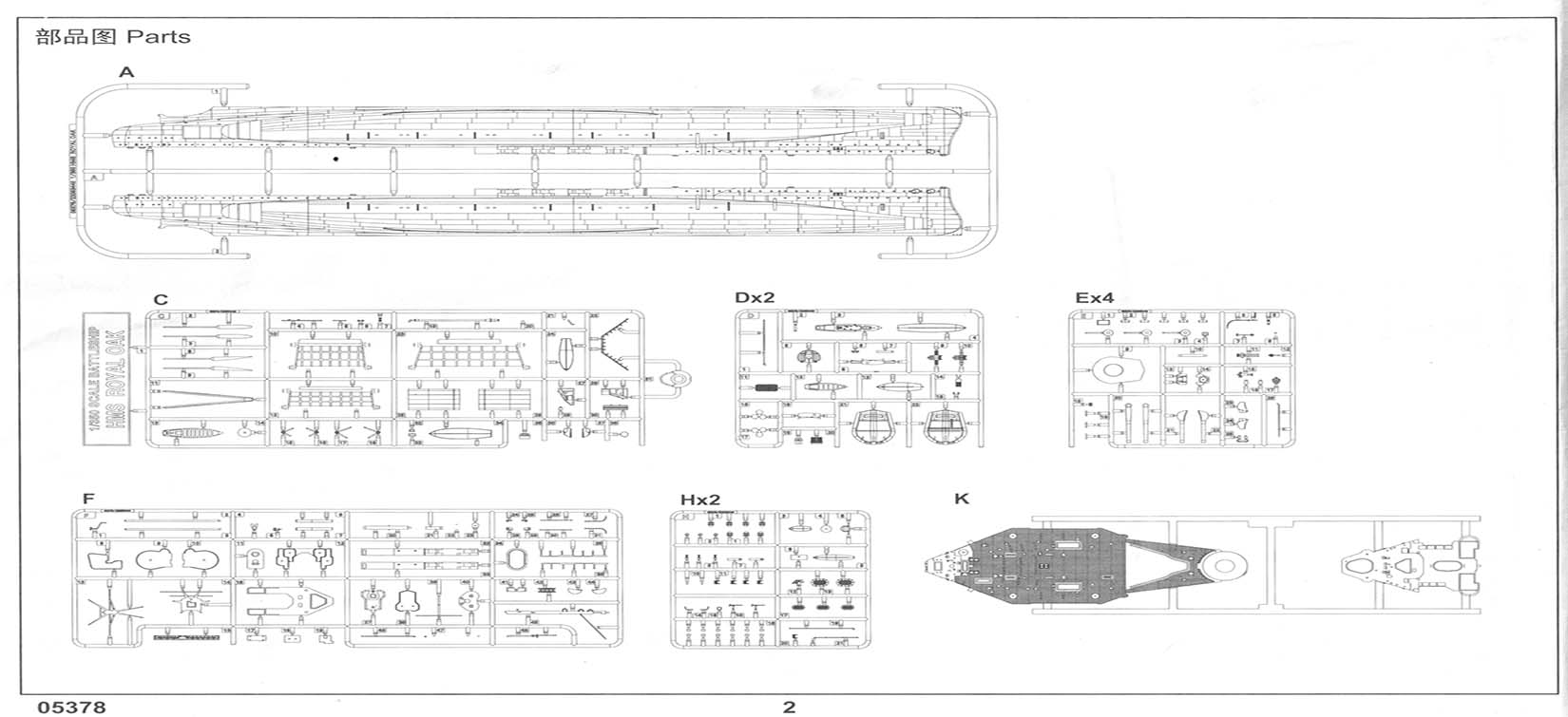
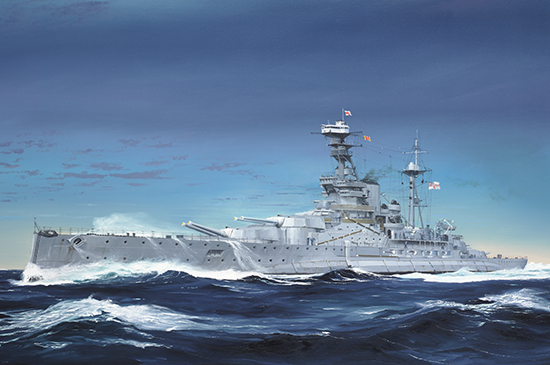
Trumpeter's 1/350th Royal Oak Kit 05378 The Trumpeter 1/350 HMS Royal Oak comes in the typical sturdy Trumpeter cardboard box with the usual painting of the ship on the top. There are over 500 parts on nineteen sprues (thirteen unique), three photo-etch frets, a separate black base, a booklet of instructions, a small decal sheet, and a small length of copper chain. No parts were damaged or had fallen off of the sprue trees when I opened the box. Royal Oak and her sisters were modernized throughout the 1930's and the kit represents Royal Oak after her final refit before the start of the war. This was early in the notion of defense from aerial attacks and this build should be more enjoyable for people who dislike building many anti-aircraft guns (there are a total of four, plus four 3-Pdr Hotchkiss guns). The photo-etch pieces are both a compliment (railings) and integral without plastic alternatives (crane, platform supports, and pieces of the Octuple Pom-Poms), so those without the desire or dexterity to handle photo-etch should take note. Plastic parts breakdown holds no surprises for those who have built a Trumpeter kit before.
|
|||||||||||||||||||||||||
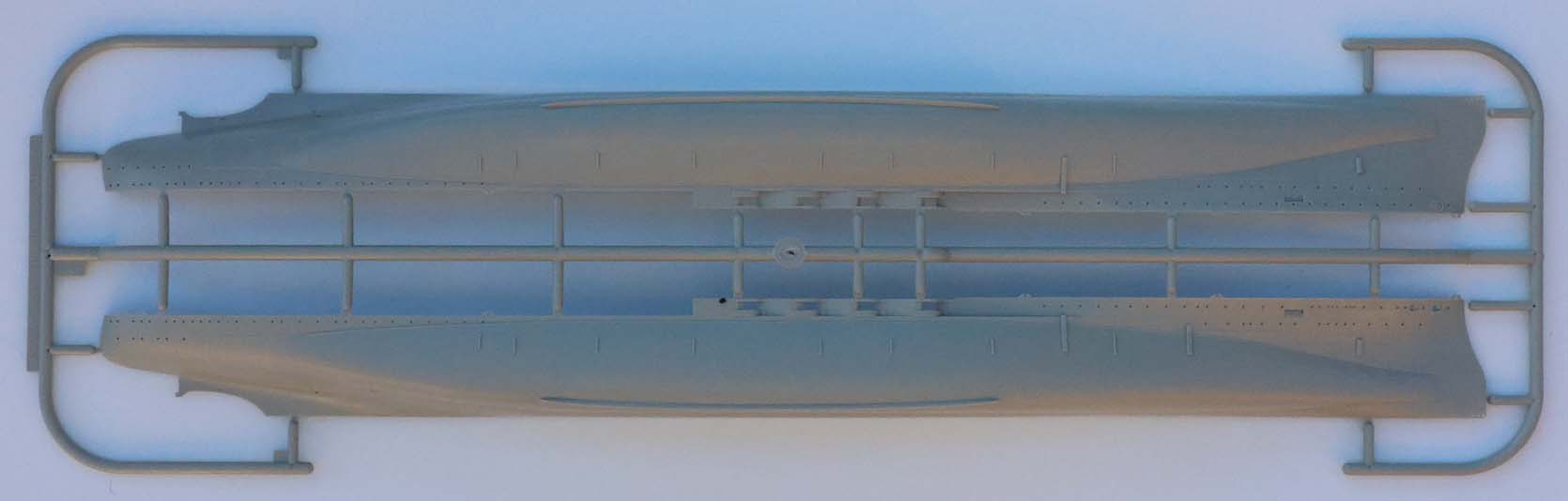
| SPRUE A Port & Starboard Hull halves |
|||||||||||||||||||||||||
|
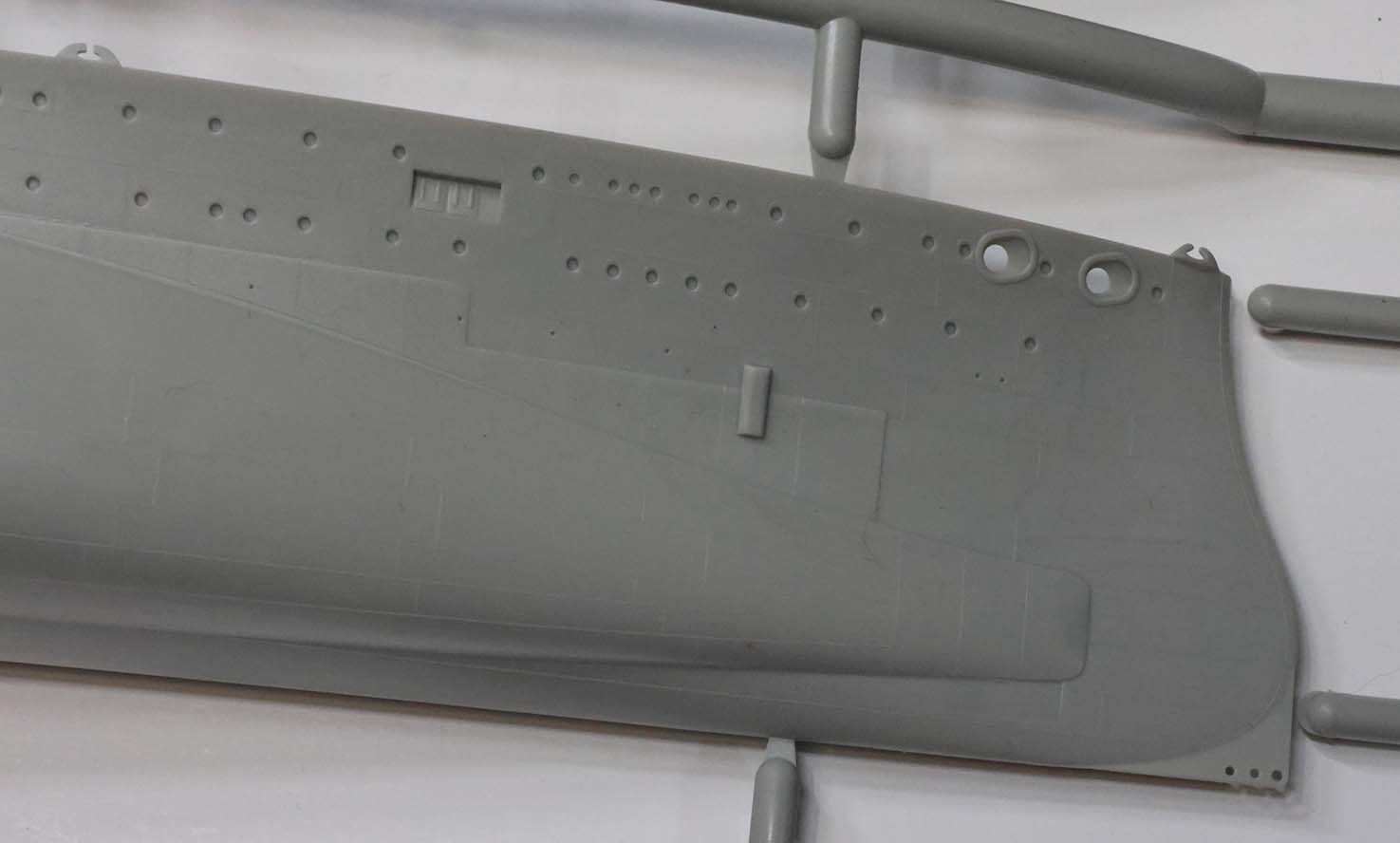
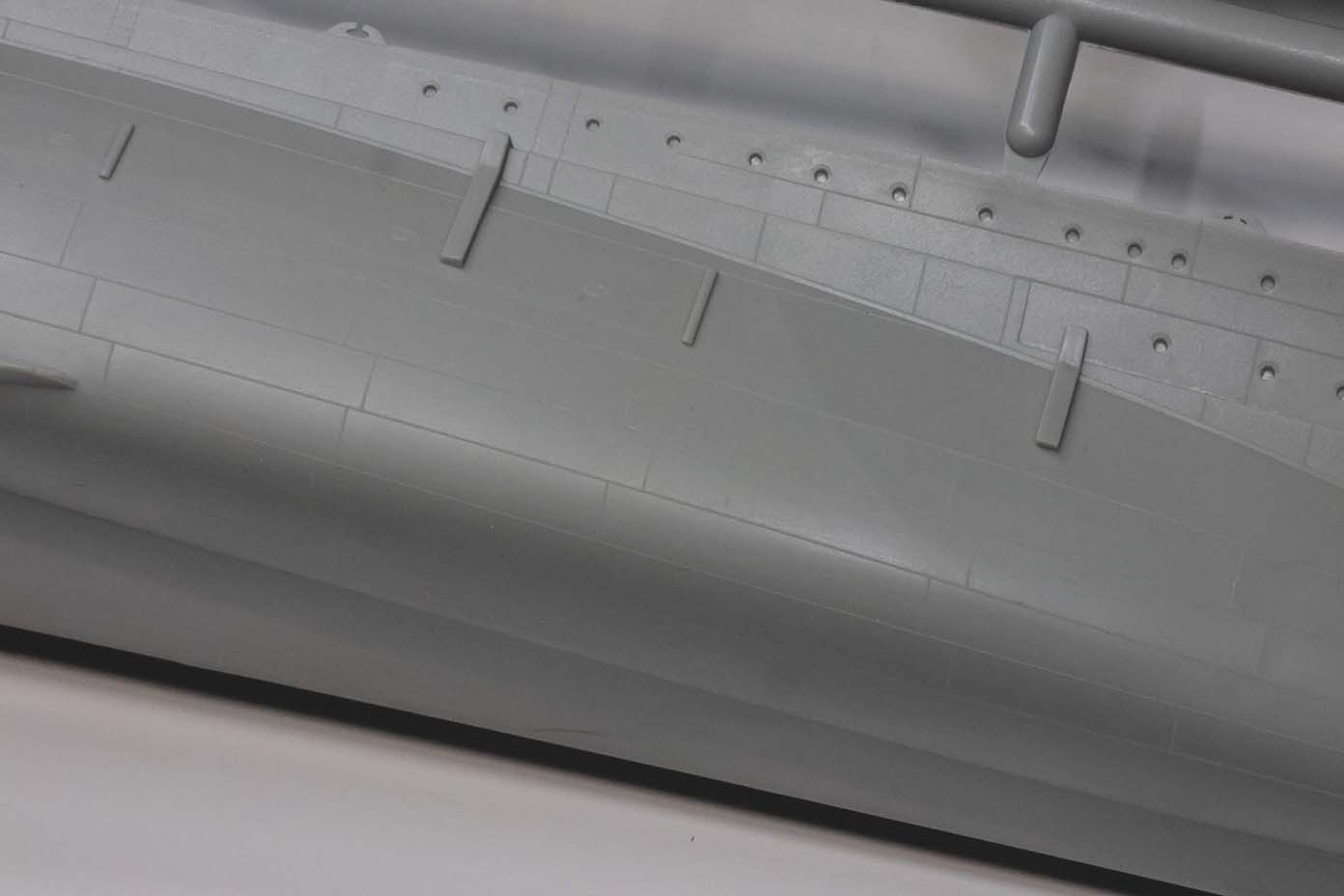
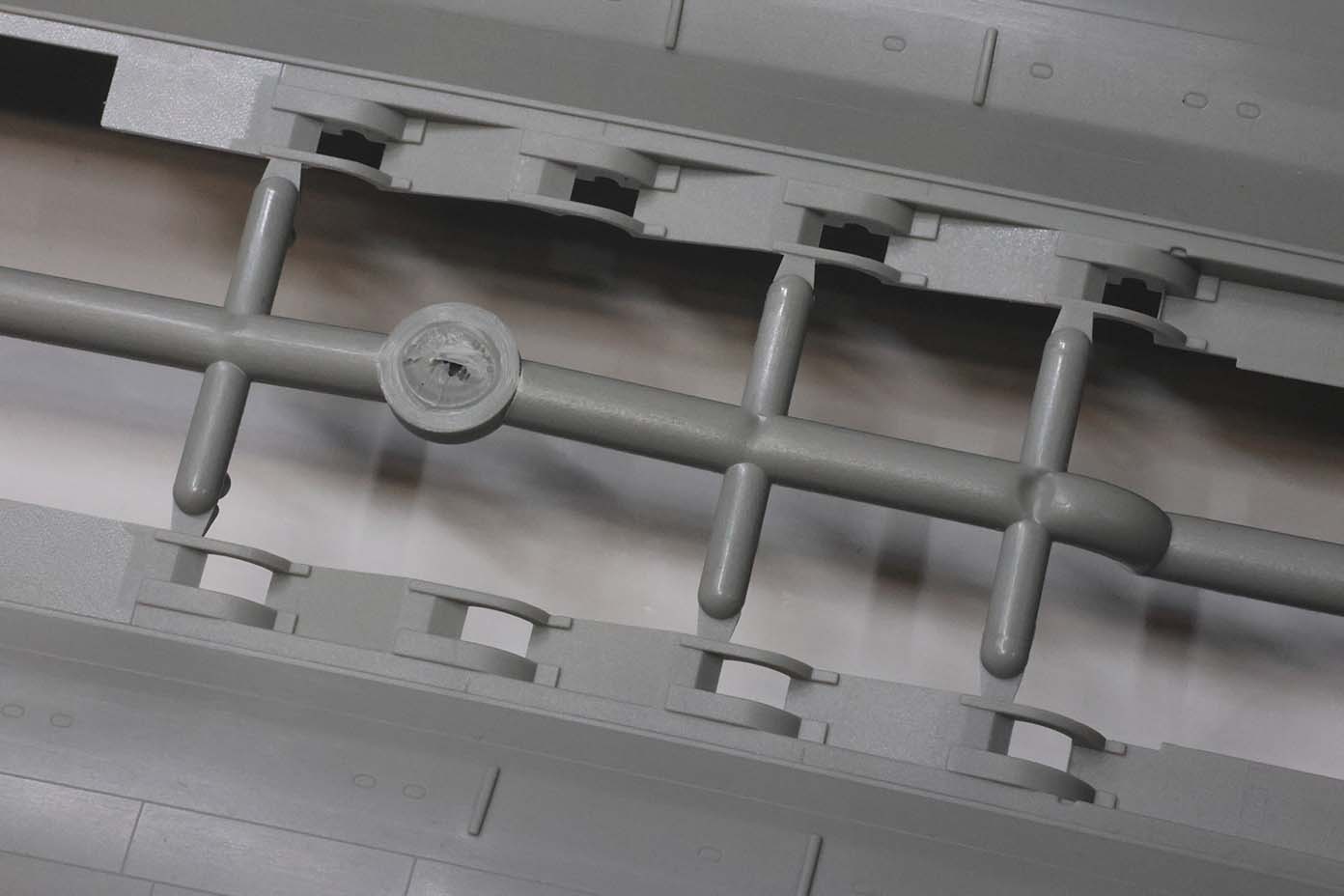
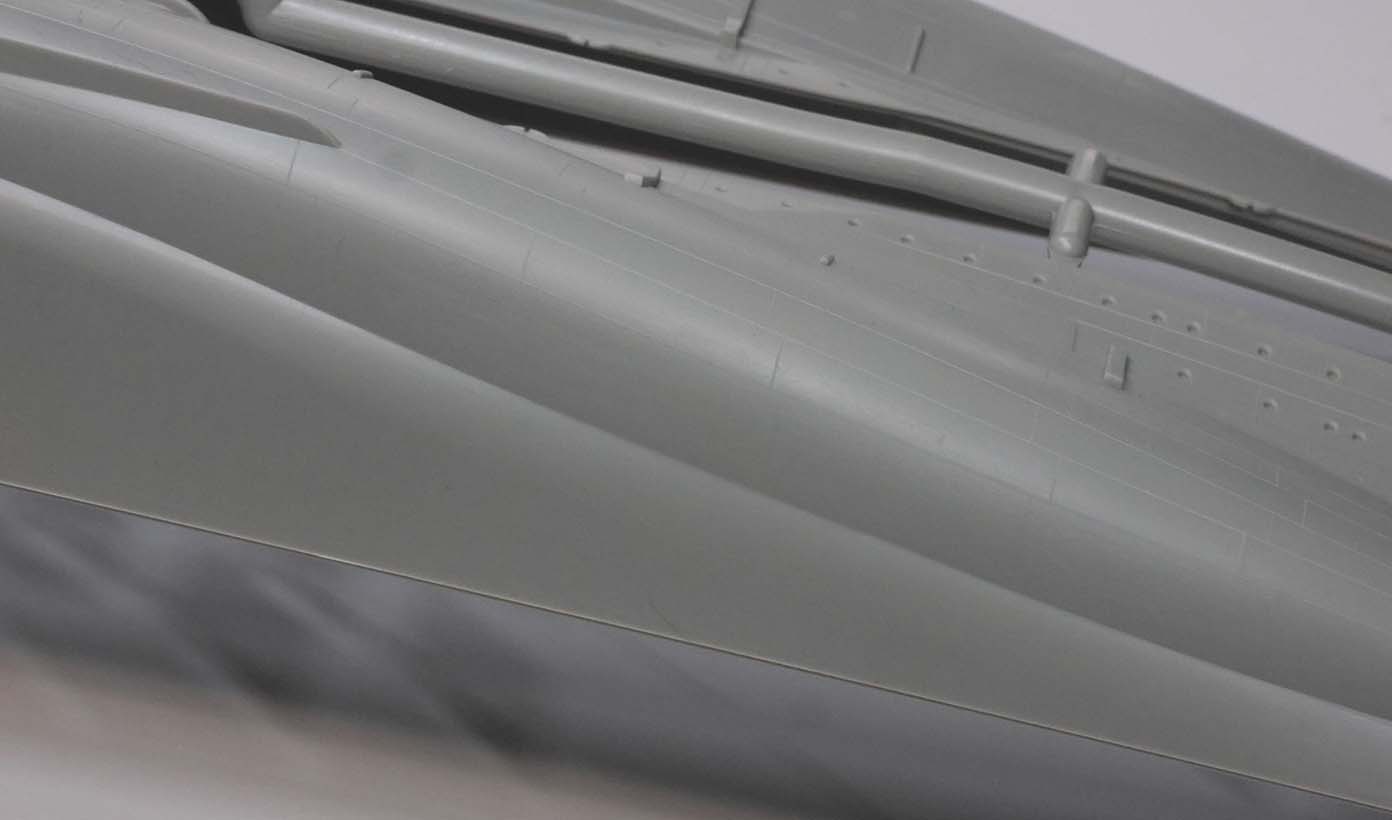
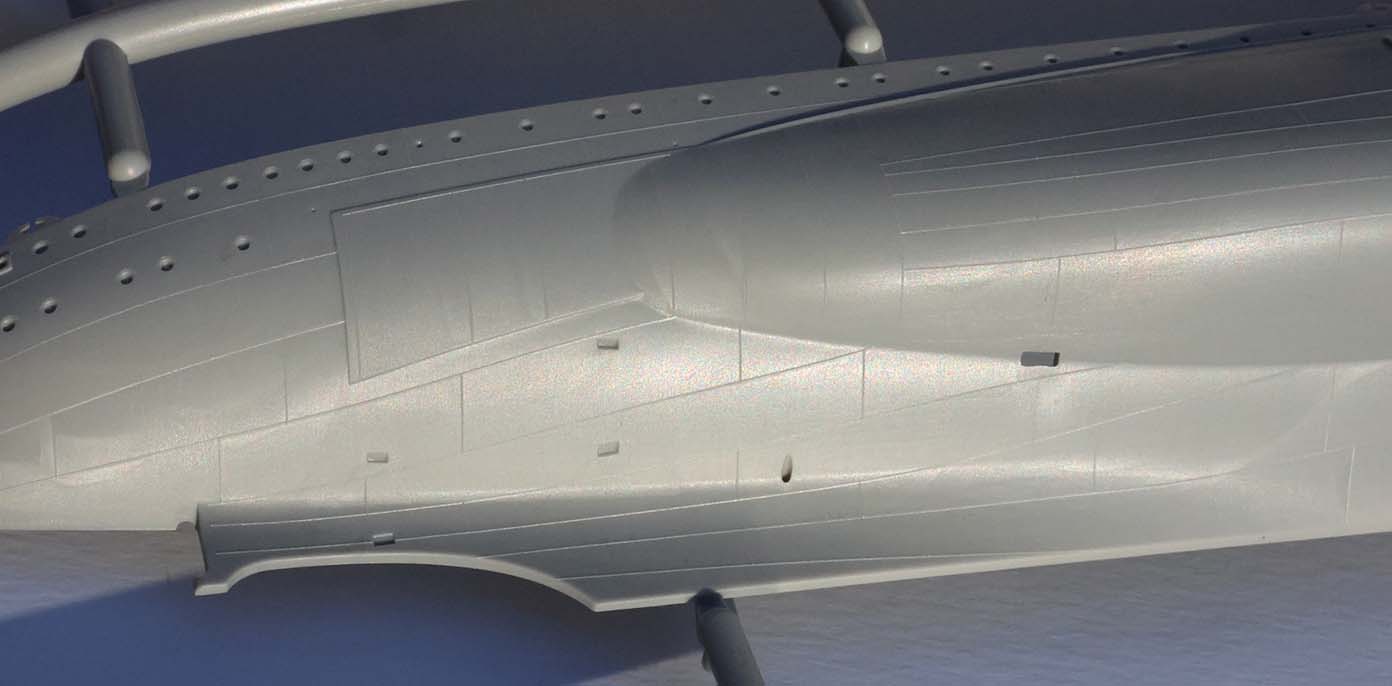
"A" tree has two pieces to make a full-hull rendition of the ship. There are no interior guides molded in to aid in cutting away the portion below the boot topping to create a waterline option. Three stiffening bulkheads are included on the "C" tree (oddly there is no "B" tree) that are probably unnecessary in most cases but may aid in lining up the main deck pieces for some. The attachment points along the deck edge are molded to negate clean up in the deck edge groove whereas the gates on the bottom and stern of the hull are up against the mating surface to protect (non-existent) surface detail. A nice and thoughtful effort largely for nought. Deck edge chocks are thin and hollow and better than earlier releases, but could still benefit from some of the new 3D printed resin offerings. The forefoot paravane skeg has three holes whereas photos of the wreck clearly show two (some independently drawn plans such as Kagero's and the Profile Morskie set show three but the wreck and Royal Navy official plans show two), but this should be trivial to fill in and sand. Portholes are appropriately sized and appear to match the layout of the ship, although I do not have authoritative plans for the port side and did not measure each one. There is a slight oval component to portholes at the very stern, but all told they are crisply molded and look good. The porthole eyebrows are incredibly fine and barely visible in some instances. There is raised hull plating detail molded on the hull; however it is rendered in fairly fine raised lines and not actual raised plates that would be a serious amount of work to remove as in earlier releases (such as the CV-5 / CV-6 kits in 1/350th) for those who choose to do so. Application of these hull plating lines is inconsistent - it is present on the original section of the hull and refitted torpedo blister below the waterline, but not above the blister's waterline. There is no real evidence of multi-part "slide" molding in use on the hull, and the fine lines taper into a total lack of detail on the bottom of the hull a bit after the turn of the bilge. There are no docking keels, sea water intake or exhaust detail on the undersides or hull sides. Likewise, the bilge keels are a bit thick and angle incorrectly (too shallow) and the bottom of the torpedo blisters are a bit simplified, but these are largely in an area that one would want to slap away those getting close enough to actually be able to see this detail. I lack the plans to give a firm review on the shape of the hull, but see enough differences in shape between the kit hull shape and some sectional drawings from the National Maritime Museum of Greenwich that I hope someone comes along with more plans and can give us a more in-depth review. I suspect that there are very few at this point that could point out shape discrepancies, if they exist, and will end with "it certainly looks like Royal Oak's hull based on the photos I have seen." |
|||||||||||||||||||||||||
|
|||||||||||||||||||||||||
| SPRUE C Transverse interior supports, prop shafts and struts, funnel, armored conning tower, and some ship's boats |
|||||||||||||||||||||||||
|
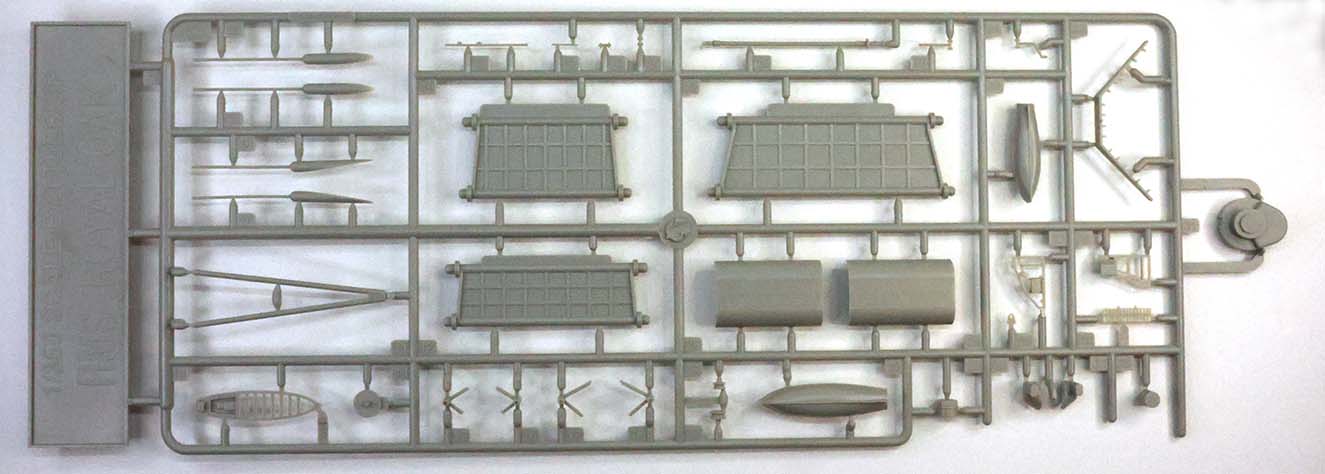
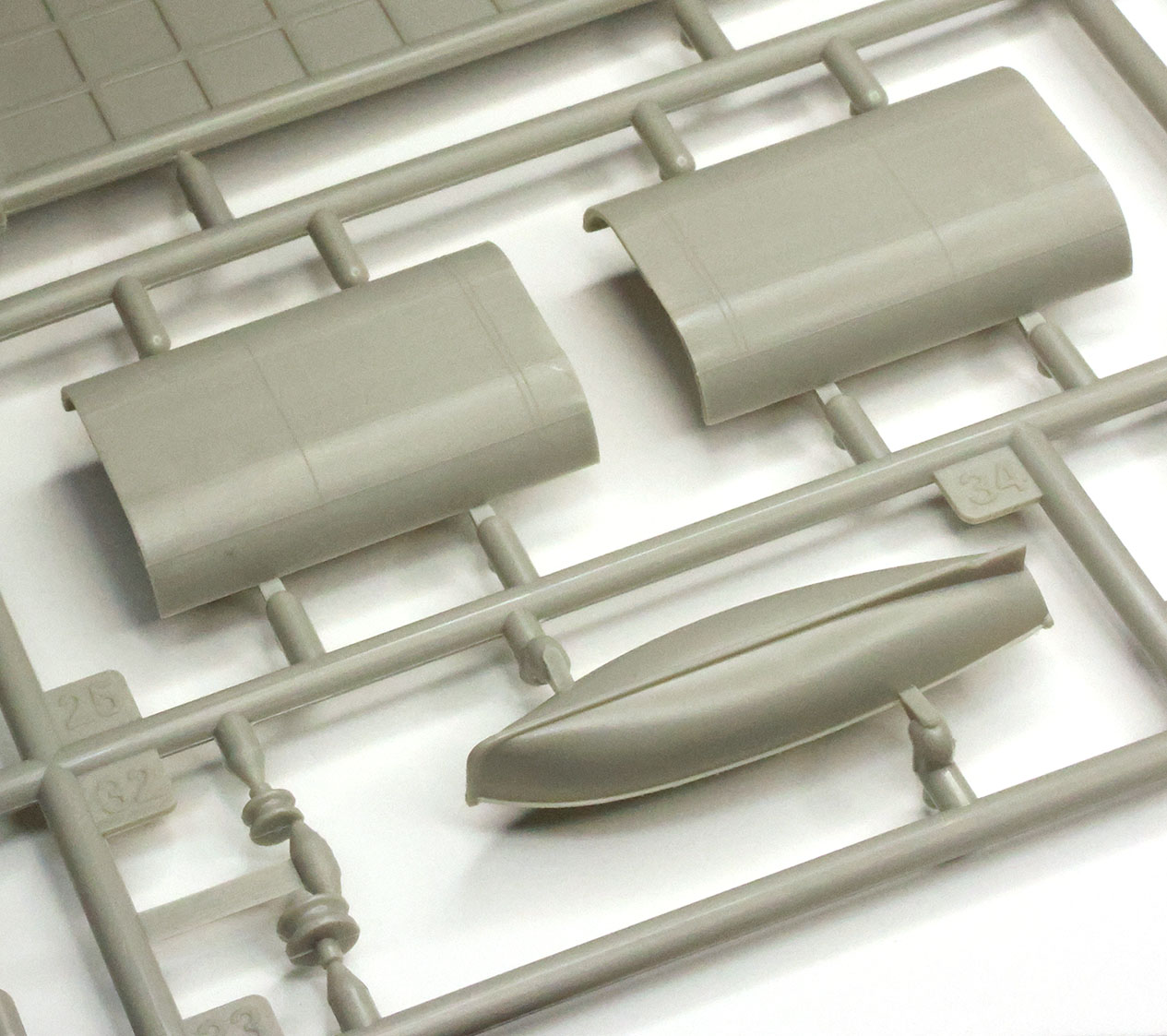
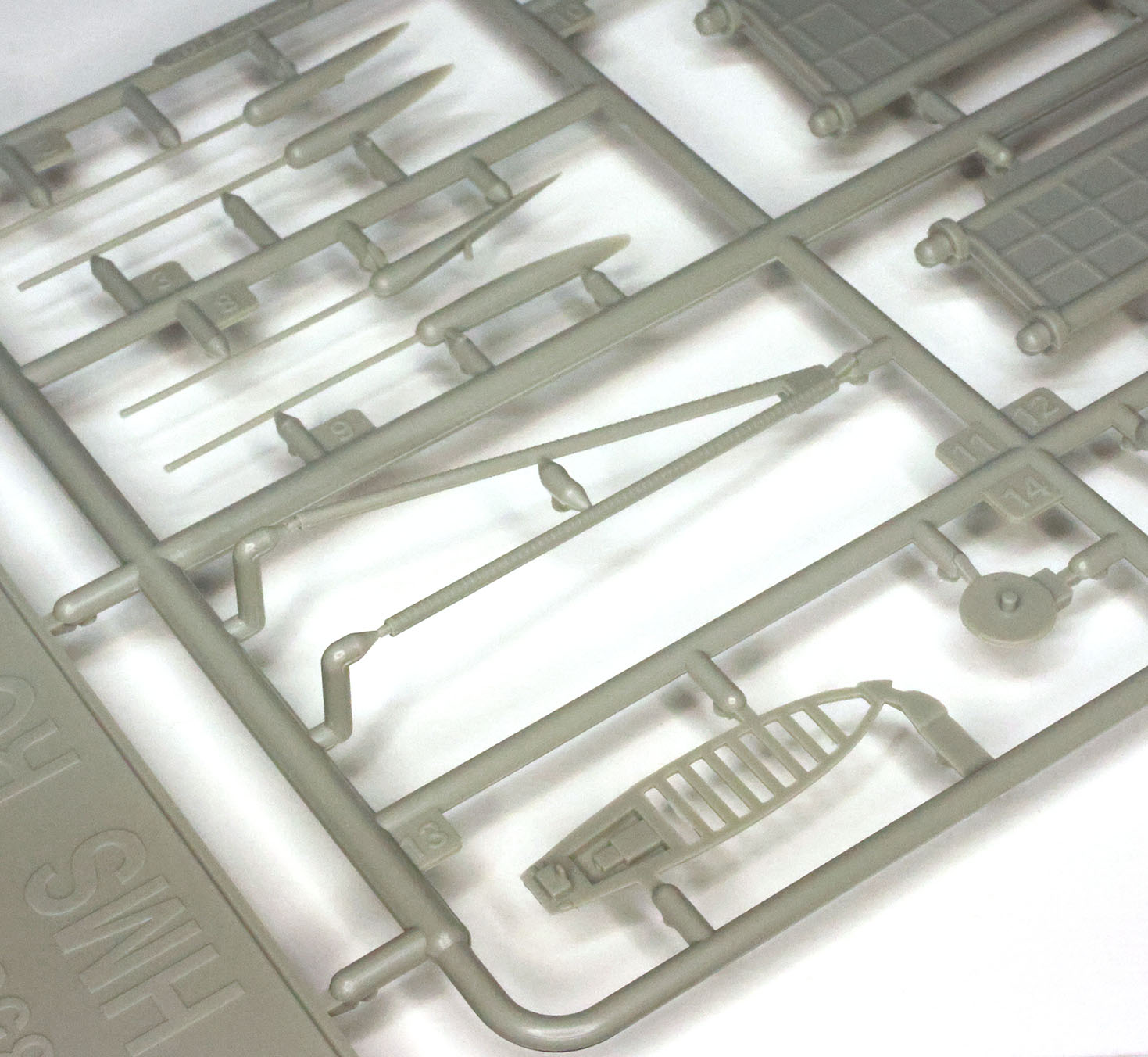
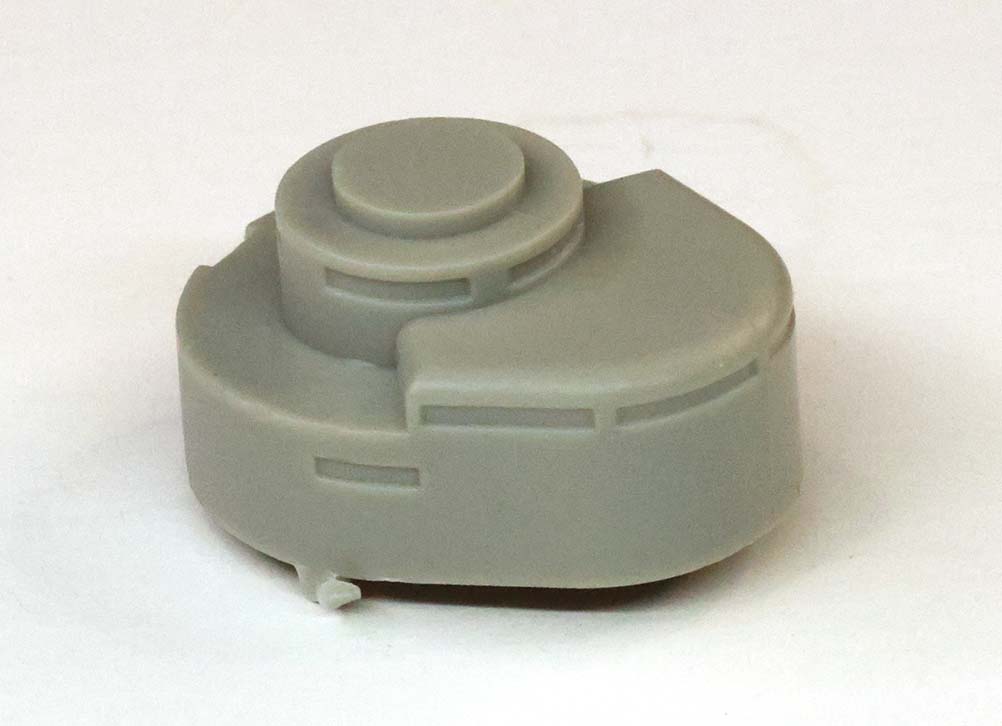
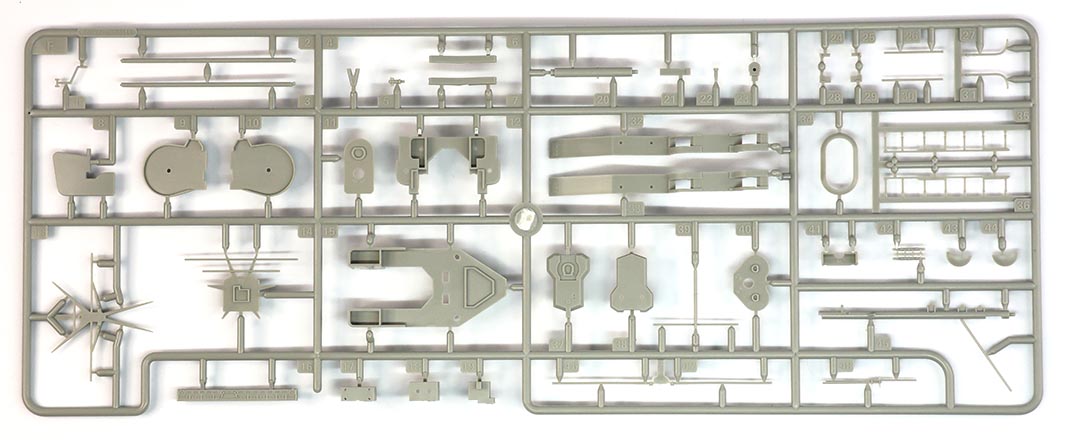
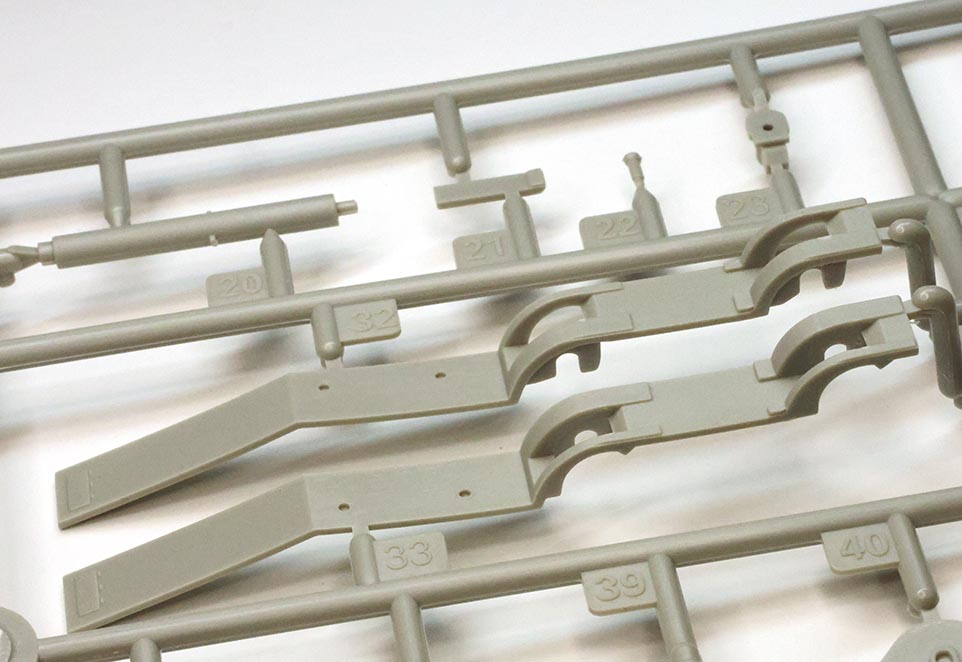
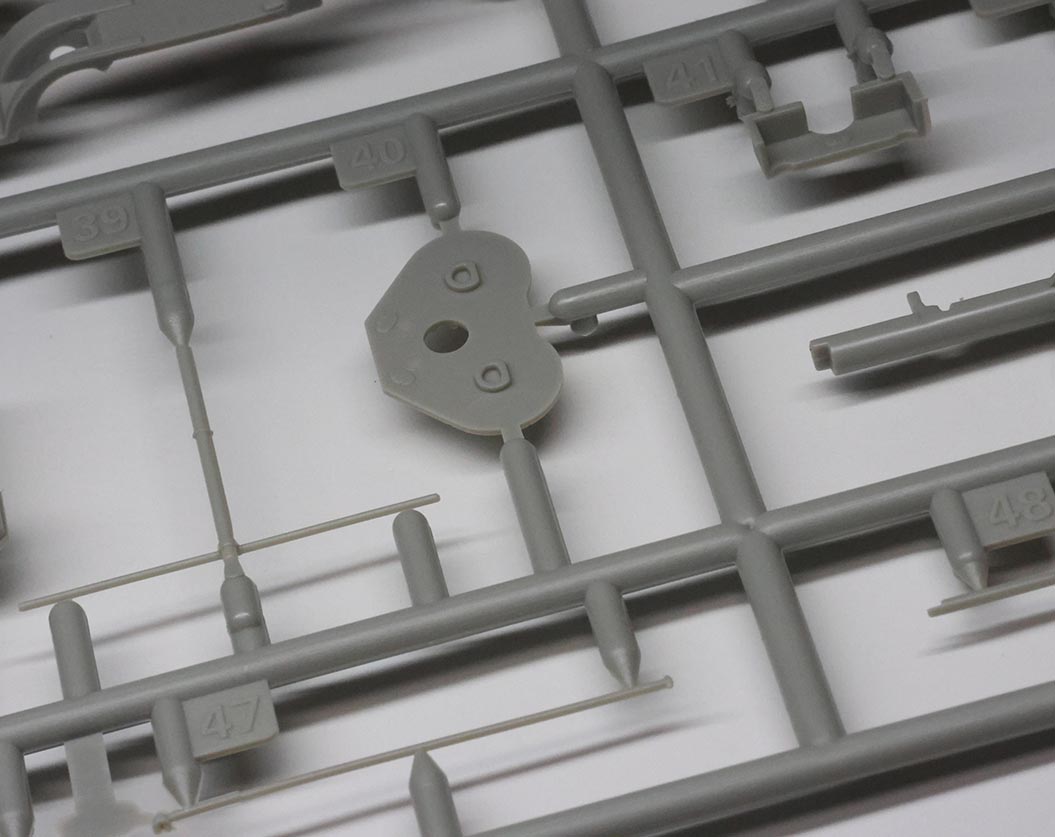
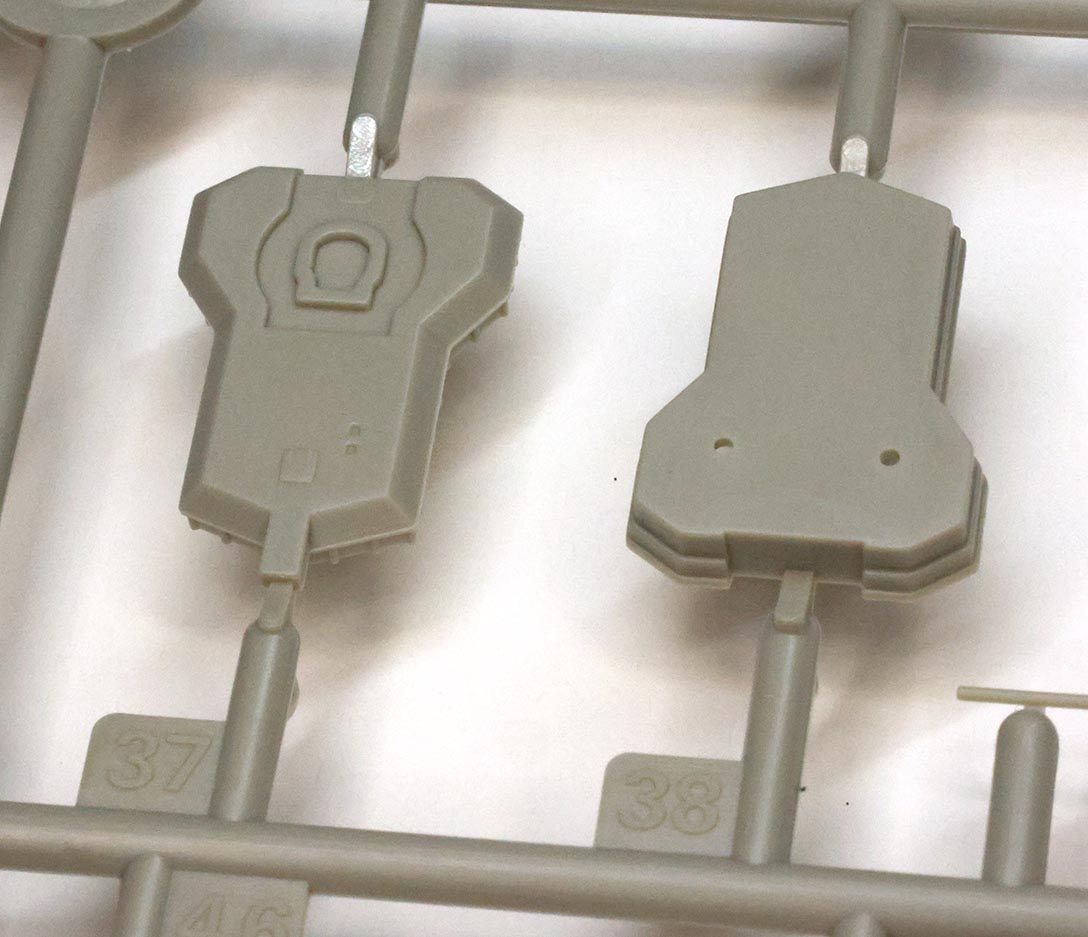
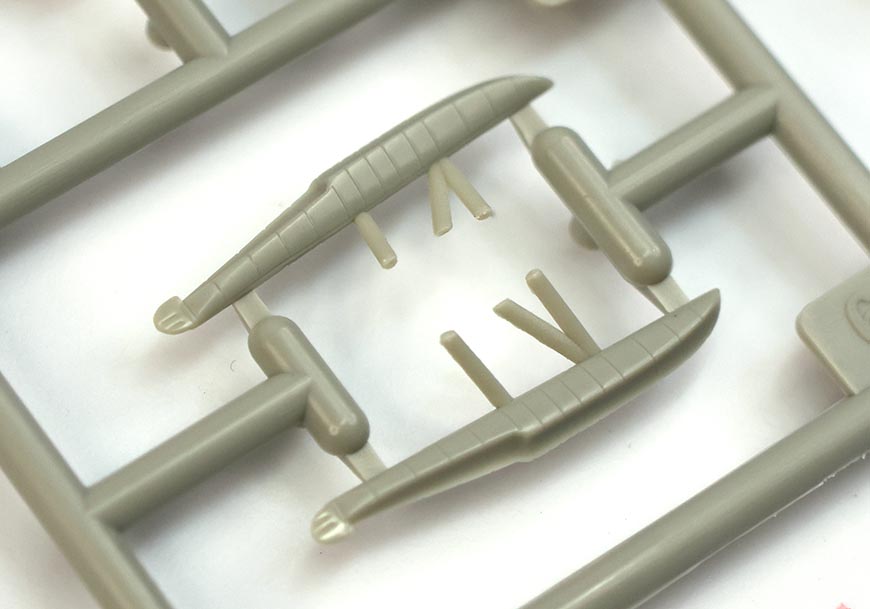
This tree has three internal bulkheads, propeller shafts and struts, some boats, and funnel as the main subjects as well as some miscellaneous poles and platforms and the 15" gun director. Parts are thin and well detailed when appropriate although there is a bit of flash here and there which will require clean up. A typical weakness I wish Trumpeter would get beyond is that the "A" frame struts to support the shaft and propeller in place are completely squared off whereas they should be tapered like an airplane wing for reduced drag and turbulence. The armored (armoured for our commonwealth friends) conning tower is at the very end of the tree and has been slide molded to allow for the vision slots to be molded in relief. This has left a very faint "Y" shape of mold seams on the roof of the conning tower - I expect some light and quick work with a file, sanding stick, or sand paper will remove this. The breakwater on the bow is a little simplified and the profile in the center incorrect. This is another piece that a good after market could help improve with a replacement. Royal Oak had nine different types of boats (this is before we even get into Carley Rafts) and "C" tree has two of the thirteen total that should be present. There are two instances of stacked boats where the top boat is missing and not provided. In both cases the missing boat is a 27' whaler, which are available from site sponsors Black Cat and Micromaster. One of the boats on Tree C is a "Bottom" boat of a stack where the boat that sat inside is not provided. Parts C13 (inner details) and C34 (hull) form a 45' motor launch, which had a 27' whaler nestled inside that is not provided on any of the other trees in the kit. Part C14 appears to be a 36' motor pinnace, but should have been a 35' Admiral's barge according to plans. |
|||||||||||||||||||||||||
|
|||||||||||||||||||||||||
| SPRUE D (x 2) Turret gun houses, Ships boats, propellers, and Octuple Pom-Poms |
|||||||||||||||||||||||||
|
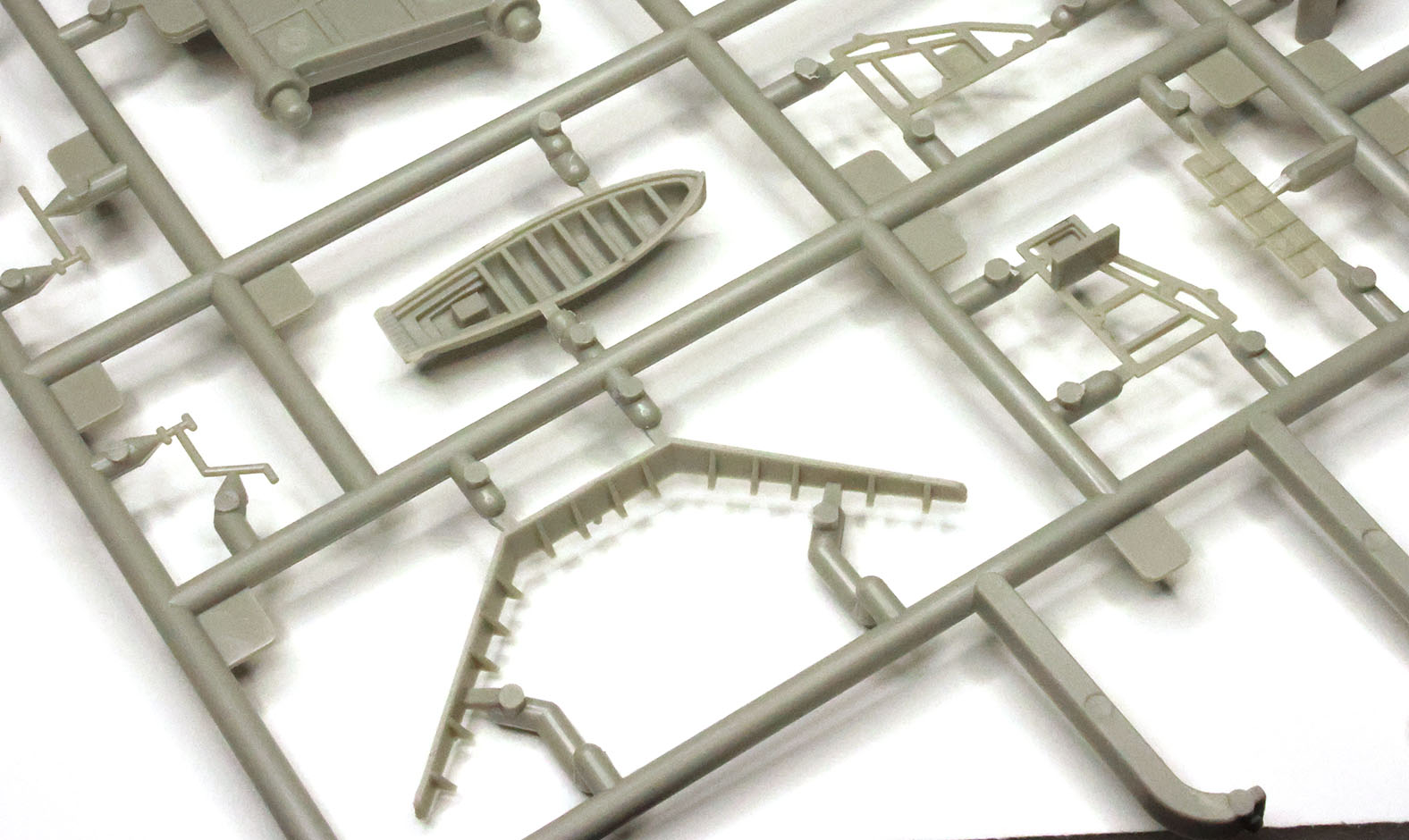
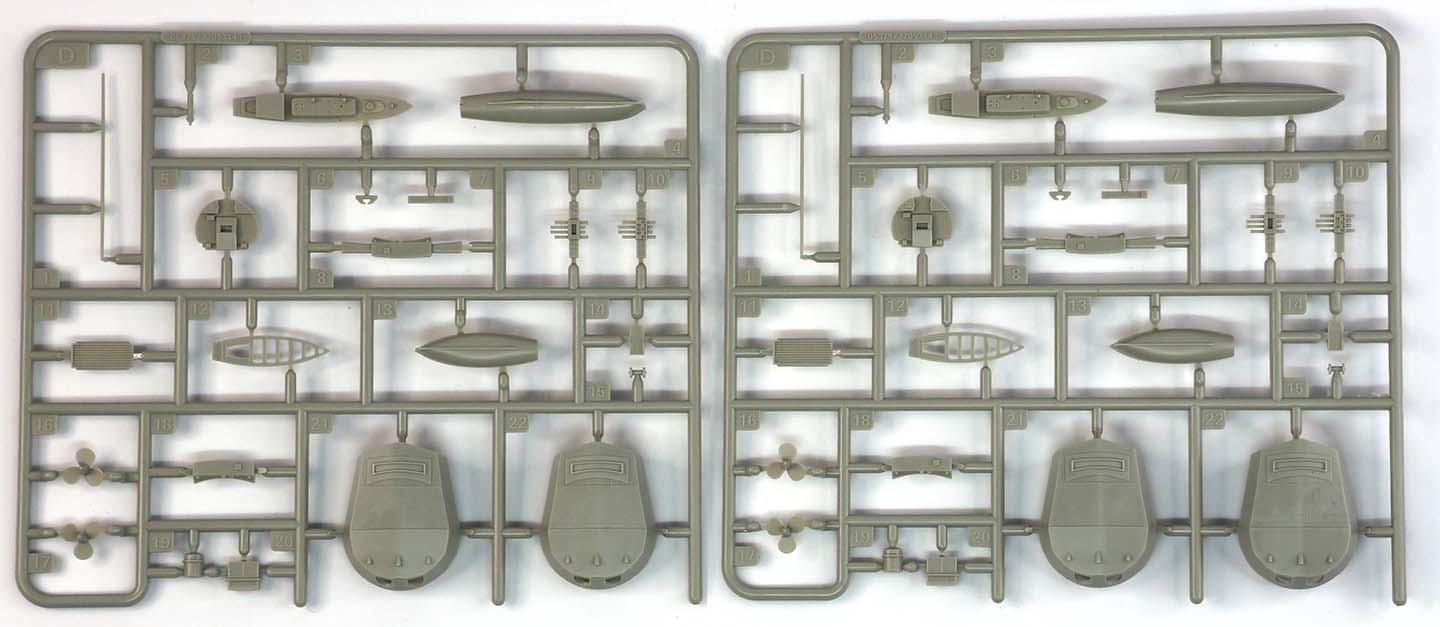
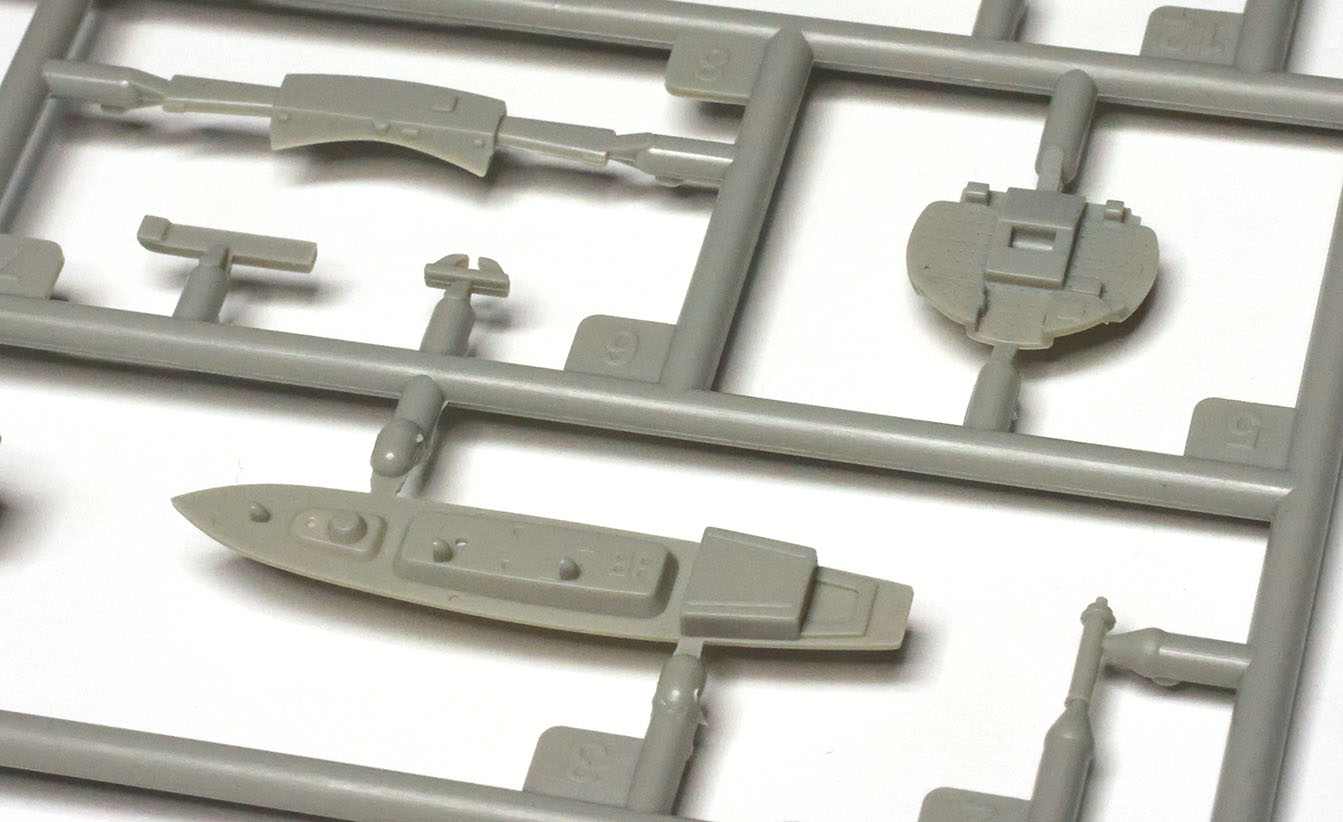
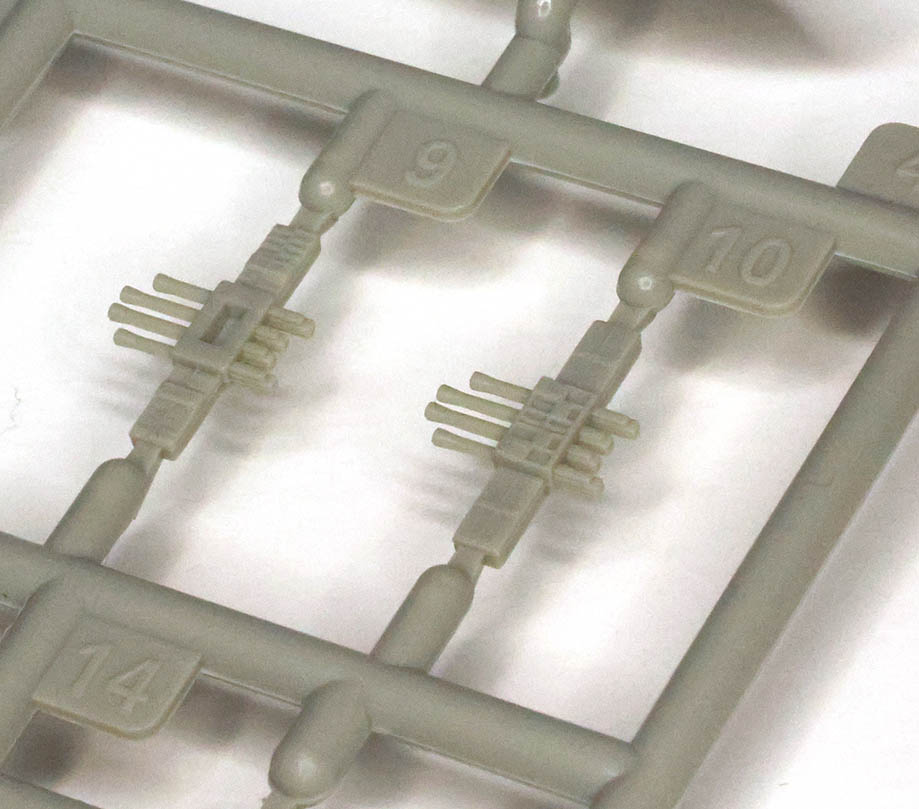
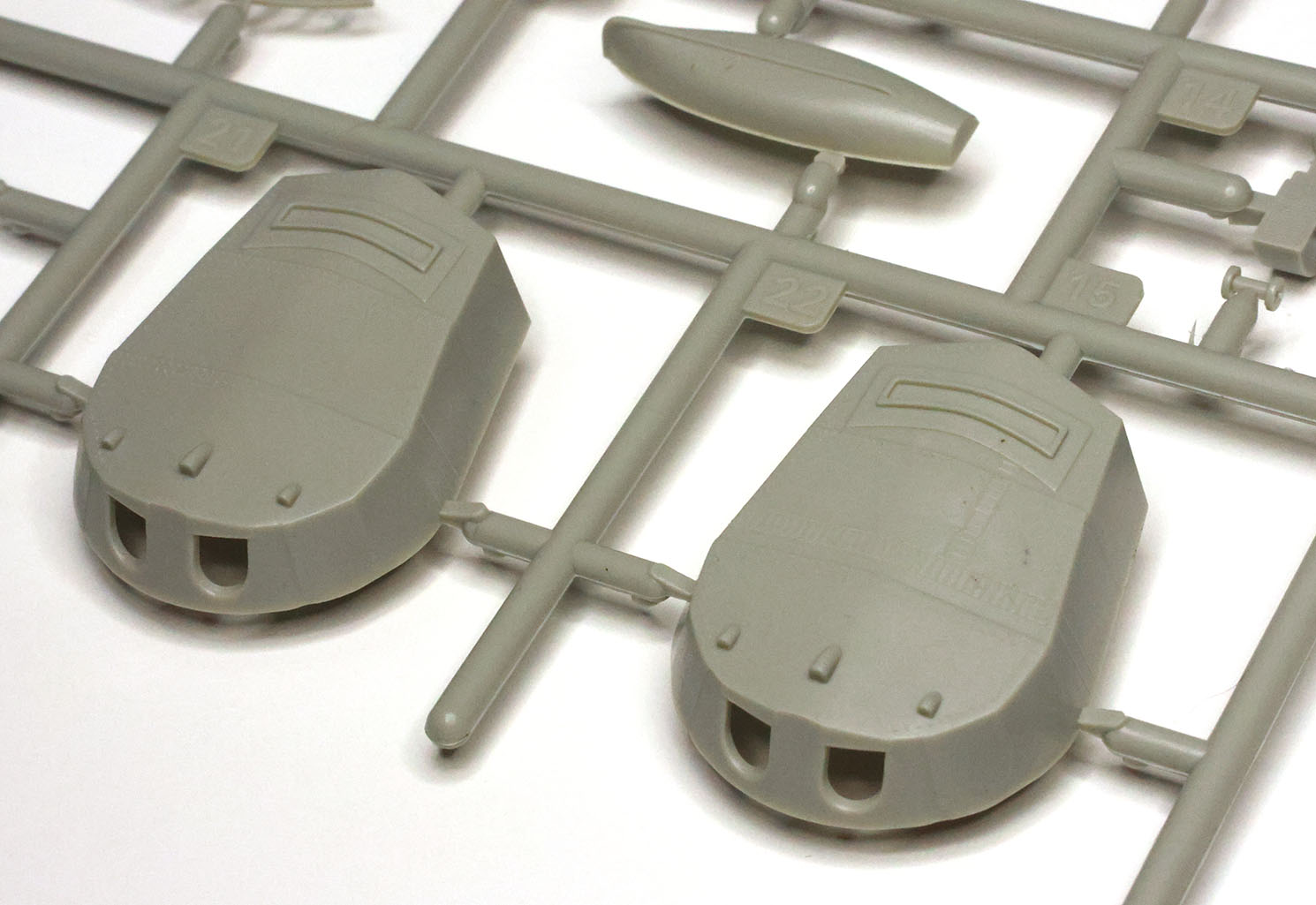
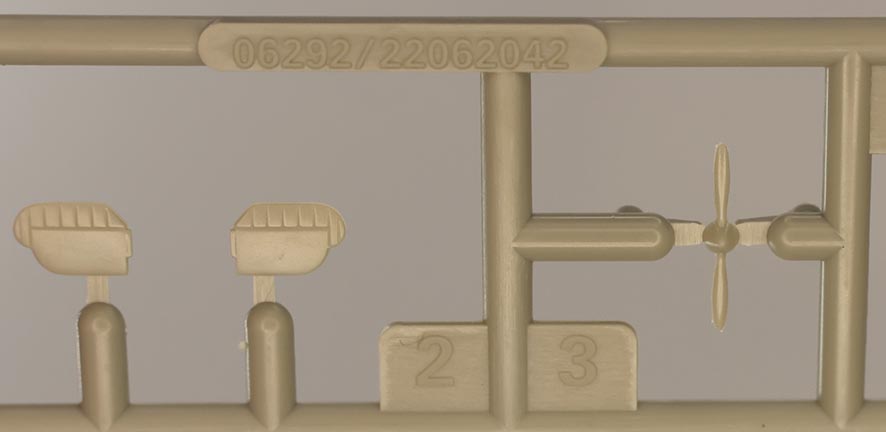
There are two copies of "D" tree in their own clear plastic bag and protective foam sheet wrapped around part and taped for protection. The four gun houses and propellers and two Octuple Pom-Pom pieces are on these trees as well as the two 50' Steam pinnace gunboats and 16' sailing dinghy's. Two 6" directors (D19), two vents, and the gun houses are slide molded. This allows the openings for the gun barrels to be correct; however this means the sides where the ladders to the roofs are on Turrets B and X are smooth and photo-etch pieces are provided to rectify this. I have no references that reveal if the to clockwise and two counter-clockwise propellers are accurate, but they look decently formed and not like some chunky barn doors of the past. There should probably be a little more curve or camber to the blades and some work to taper the edges to a point is certainly possible, but these are definitely a step up from past efforts. The Octuple pom-poms are made from three plastic pieces and two photo-etch metal pieces. The Pom-pom barrels have flash suppressors molded on at the tips, which are incorrect for Royal Oak and make them look a bit more stout than they should; however the barrels are a definite improvement over earlier 20mm mounts on Trumpeter US Navy releases. The gun trunnions fit into two photo-etch pieces that represent the carriage. Those who want to avoid photo-etch at all costs might look into resin 3D-printed replacements. Tree D is also a case of a missing boat in that the port side of the shelter deck had a 32' cutter with a 27' whaler cradled on top. The 32-foot cutter is provided as parts D12 and D13, but there are no parts or provisions for the 27' whaler on any tree as mentioned previously. Two 50' Pinnace armed boats for harbor protection are provided as parts D3 and D4, with rudders supplied in photo-etch. |
|||||||||||||||||||||||||
|
|||||||||||||||||||||||||
| SPRUE E 15", 6", and 4" gun barrels, twin QF 4-inch gun mount, 15" turret bases. Anchors and Davits |
|||||||||||||||||||||||||
|
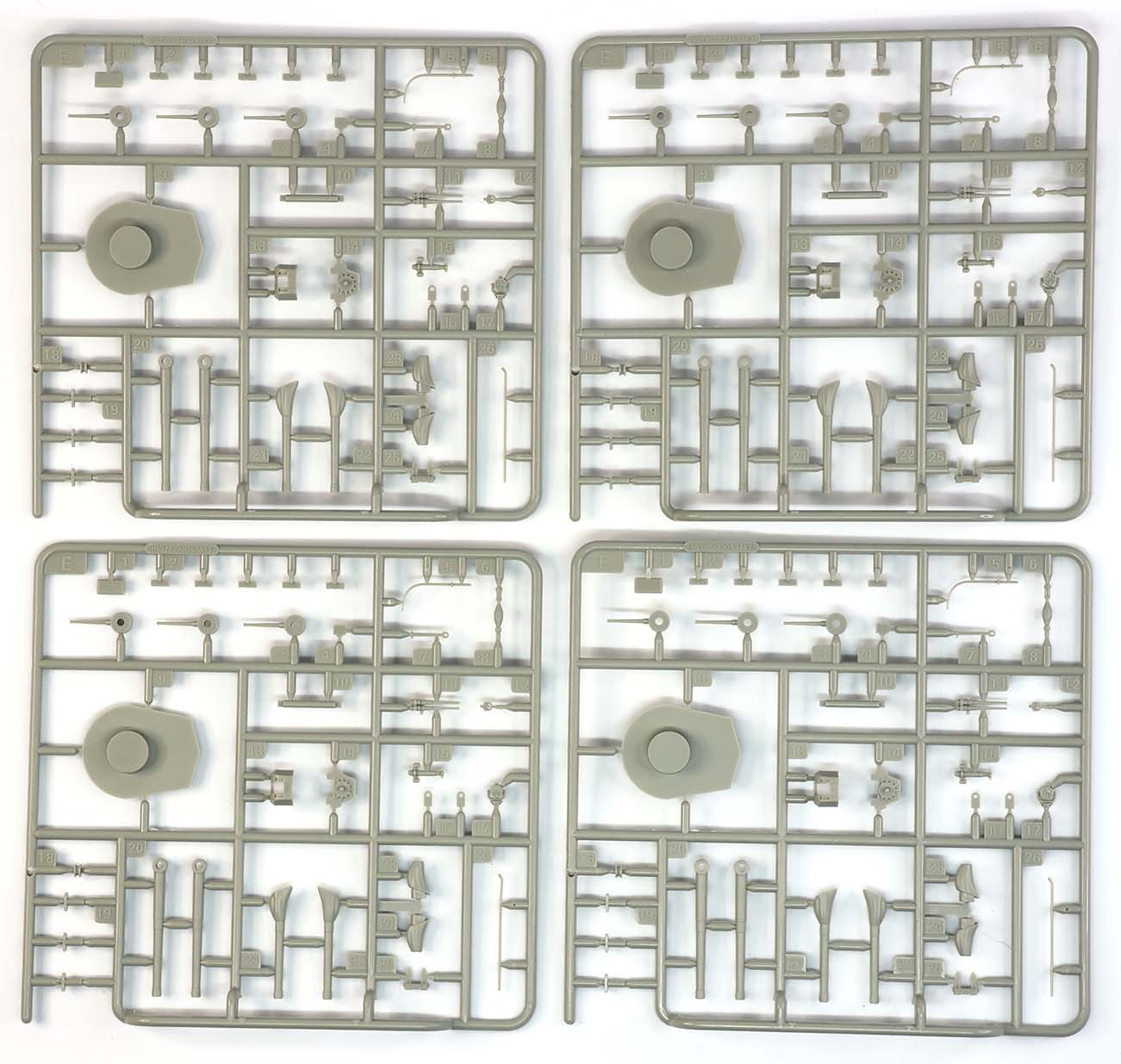
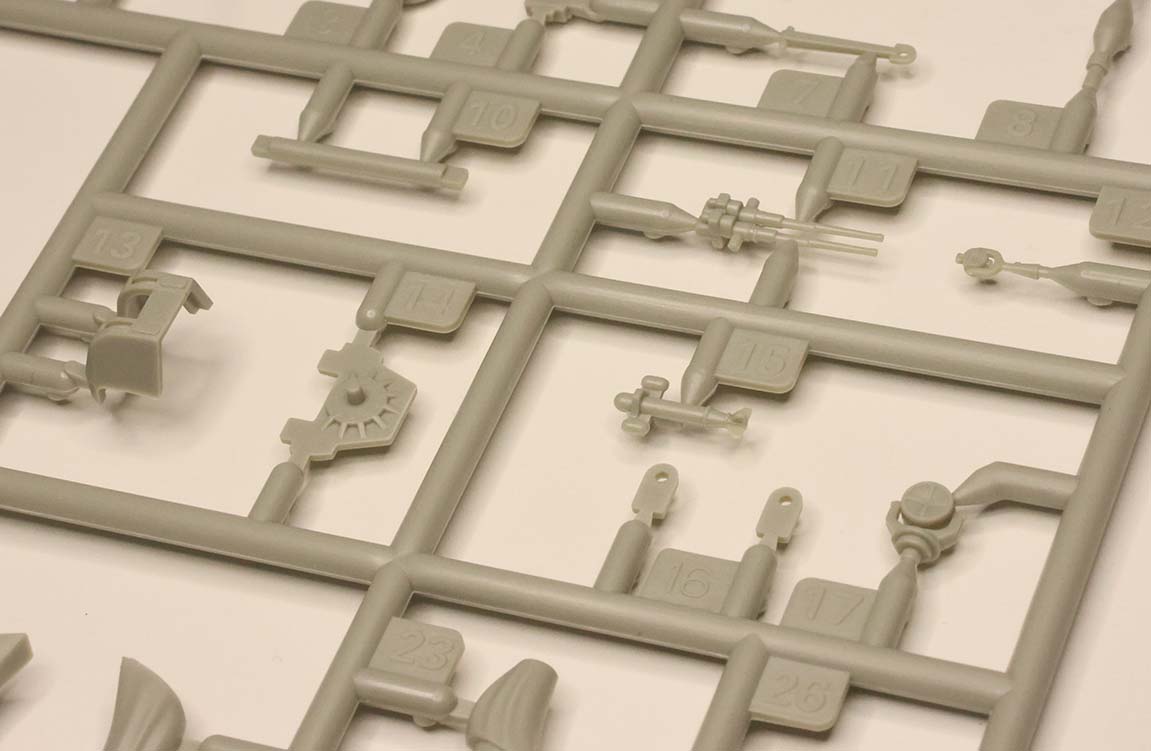
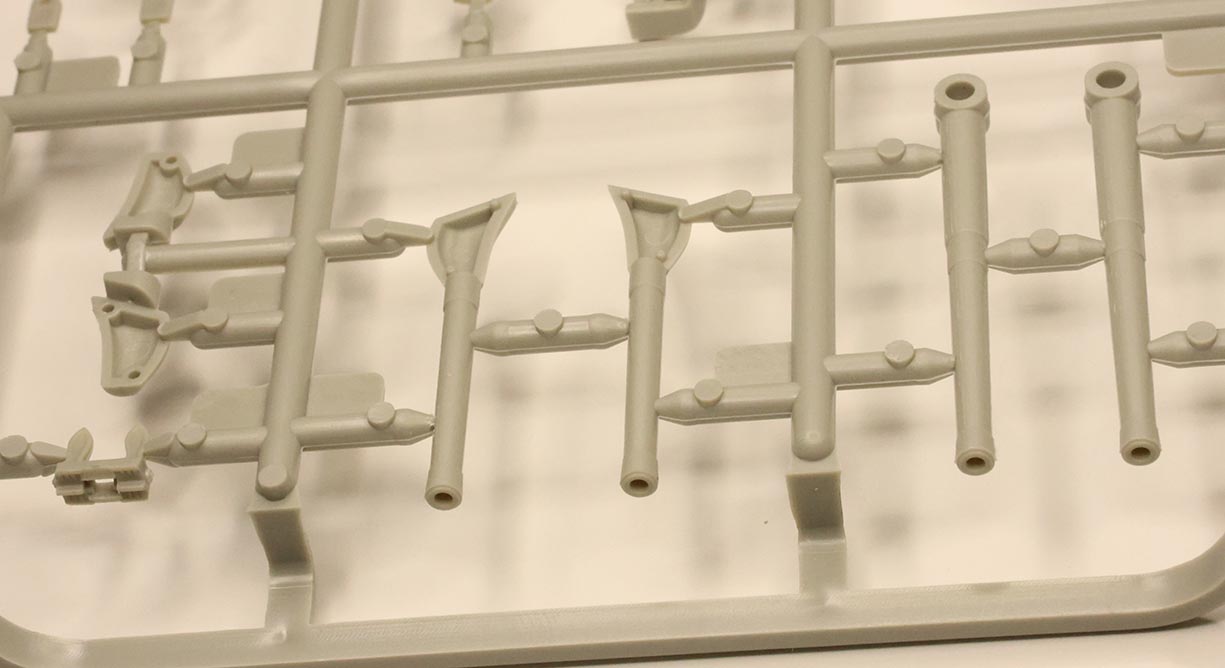
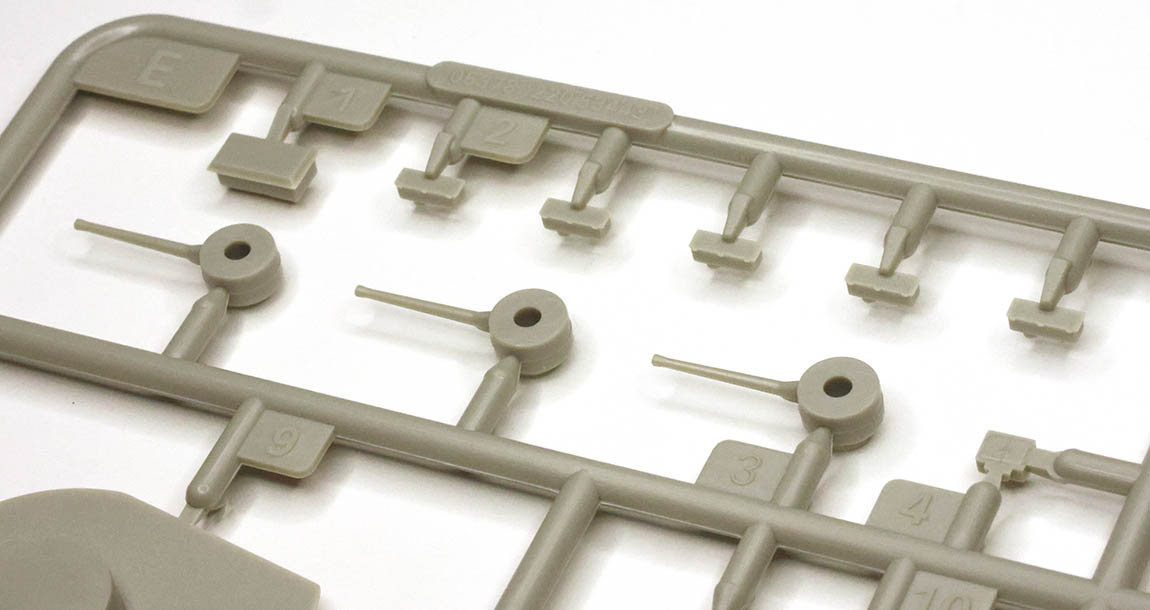
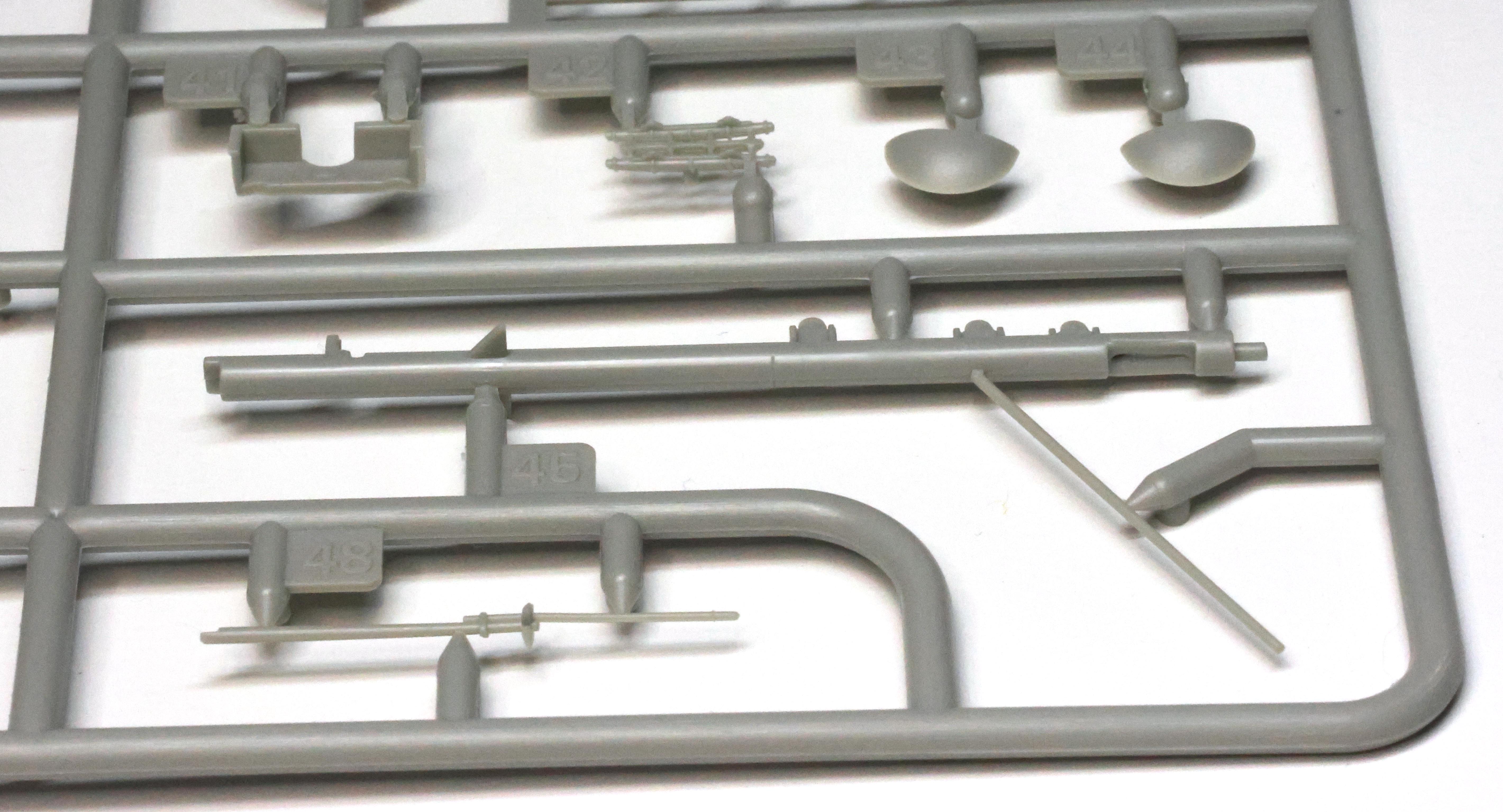
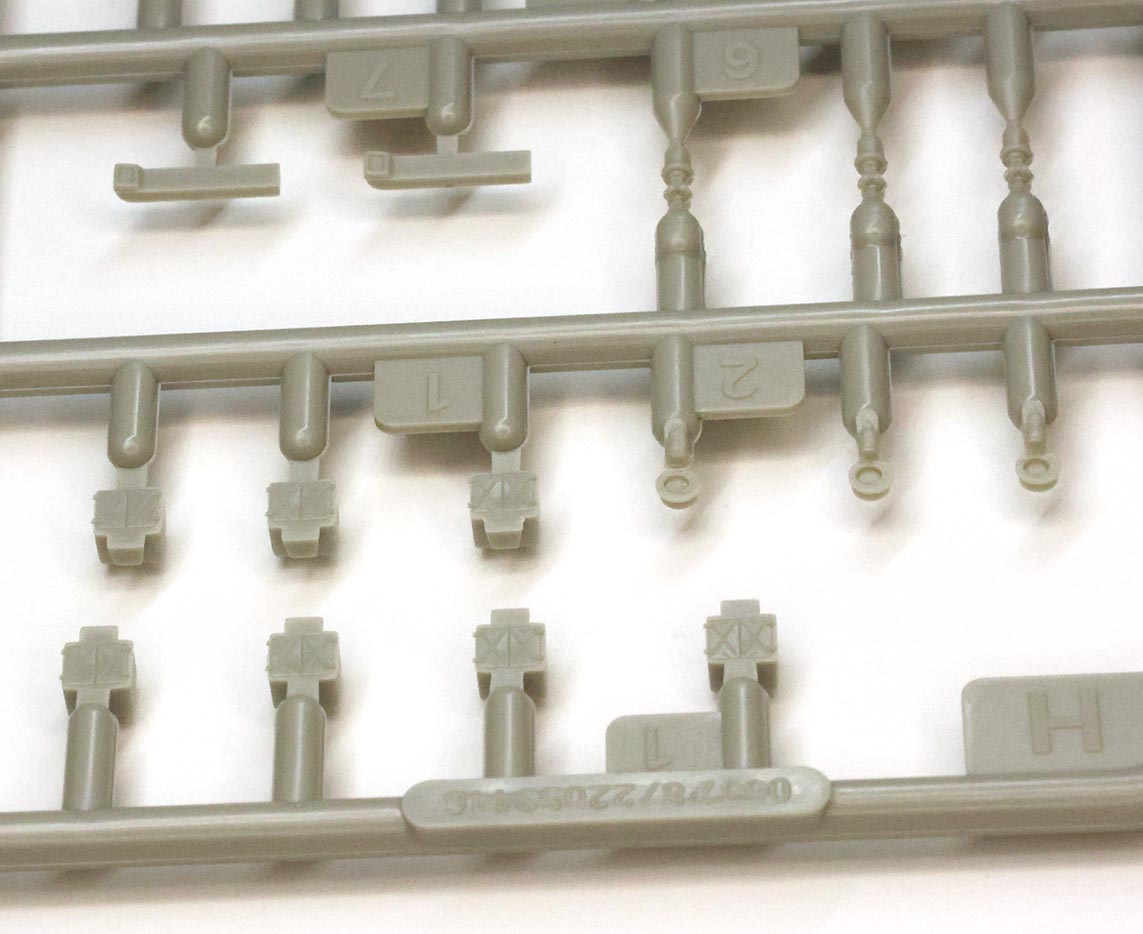
The four "E" trees complete the main armament details and contain most of the secondary armament and some miscellaneous details. There are pieces provided for the 15" barrels both with bloomers and without. The barrels are at one edge of the tree, allowing them to be slide molded so that the 15" muzzle is hollow and does not need to be drilled by the builder. The versions without the bloomers (also known as "blast bags") are positionable whereas the option with has the barrels fixed and close to a 0 degree elevation. The 6" secondary battery are molded on a horizontal ring allowing the builder to position them how they wish in train but are not slide molded for the open muzzle (however at .8 mm it will be hard to tell). The twin QF 4-Inch mount is comprised of five pieces - the base, two carriage columns, the twin 4" gun barrels as a single piece, and the mount shield. The mount is a touch basic, with the fuse setting equipment at the corner of each platform missing, but the builder can add a reasonable facsimile with some thin sheet or strip styrene or replace the guns with 3D printed resin offerings. An interesting feature is that the anchor is in two pieces, with the shank separate from the crown and flukes. This will presumably make it a bit easier to fit the shank through the hawse pipes in the hull pieces to the openings in the main deck piece. Four are provided due to the nature of four sprues and three are used on the bow - however a fourth was also carried on the shelter deck between and underneath the two 50' Steam Pinnaces and is not referenced in the instructions. The builder can either keep a spare or add an extra detail that few will see unless doing a waterline version with boats over the side. There are five horizontal deck lockers (E2) on each tree with fine detail for the latches - however each is anchored to the tree with a large sprue gate attachment that will require careful clean up to preserve detail. The provided paravanes look decent, however the searchlights are a bit thin, short, and have a slight depression on the face that may make treatment with a wash a bit harder to look as desired. |
|||||||||||||||||||||||||
|
|||||||||||||||||||||||||
| SPRUE F Bulkheads, Platforms, and Masts |
|||||||||||||||||||||||||
|
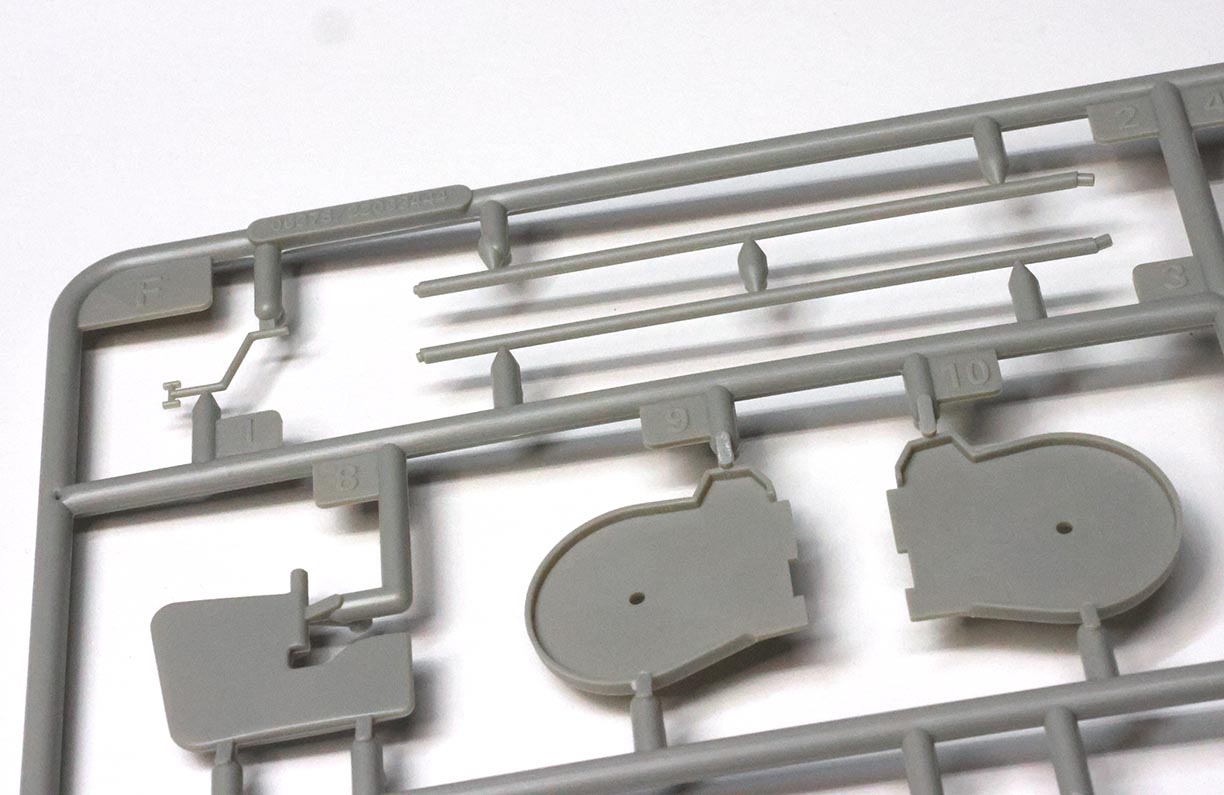
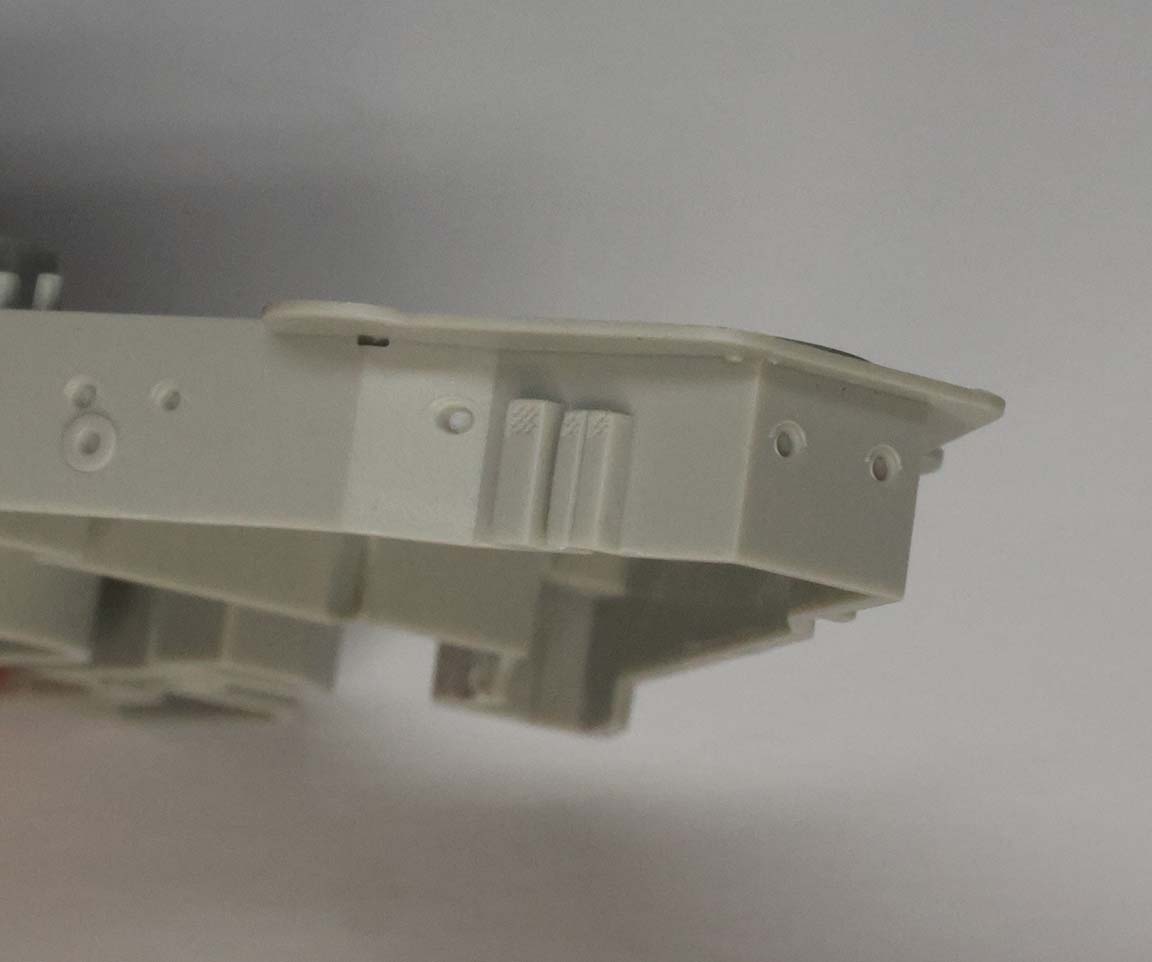
Tree F arrives completely wrapped in protective foam inside its plastic sleeve. There are a lot of masts and platforms with yardarms and other thin detail pieces on this tree. There is slight flash on some pieces in my kit, but nothing egregious. There are a couple of superstructure decks and bulkheads as well and by and large Trumpeter arranged them to leave any the knocking pin marks on the bottoms of the platforms out of sight. The searchlight platform (F12) has decently thin splinter shields, however it is flipped from the other platforms and has a few minor knocking pin marks on the deck that may be noticeable enough for some to want to fix. Two of the platforms have angled support pieces molded on the underside in plastic and two have alignment lines molded in to aid with the placement of photo-etch supports. There are some nice, subtle hatches on the top of the spotting top and 15" and 6" gun director platforms. Parts F6 and F7 are garbage chutes for the hull and look like they should fit over something, however there are instead very subtle lines on the sides of the hull that should guide placement (the instructions are a wee bit vague). |
|||||||||||||||||||||||||
|
|||||||||||||||||||||||||
| SPRUE H Ships boats and rafts, AA guns, HACS, 4" ammunition lockers, vents and hose reels |
|||||||||||||||||||||||||
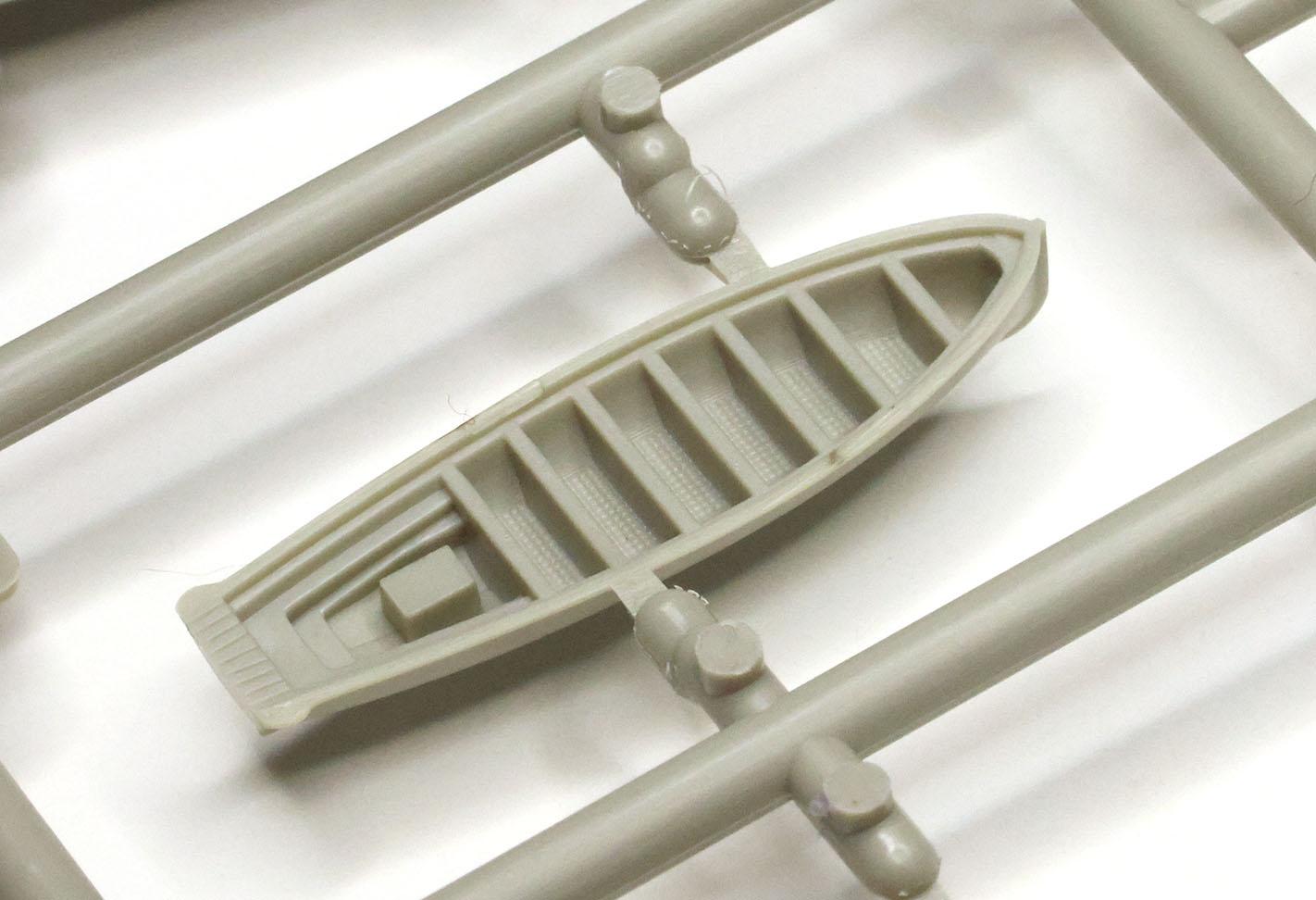
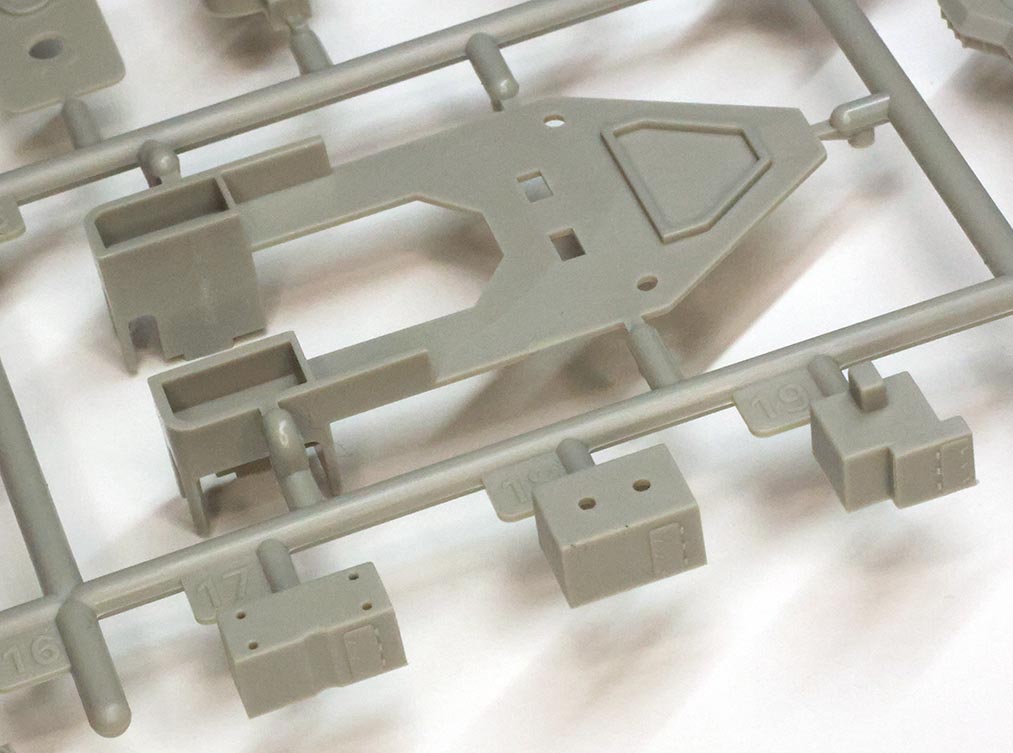
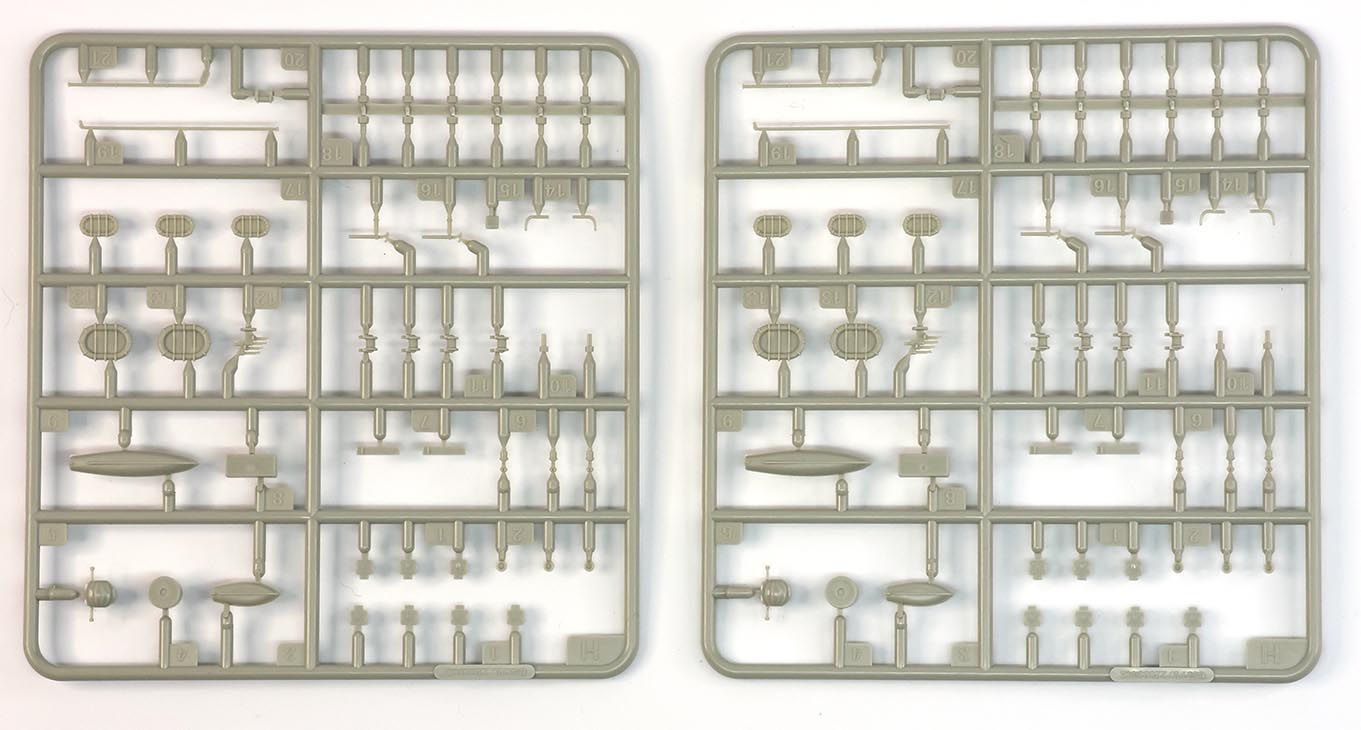
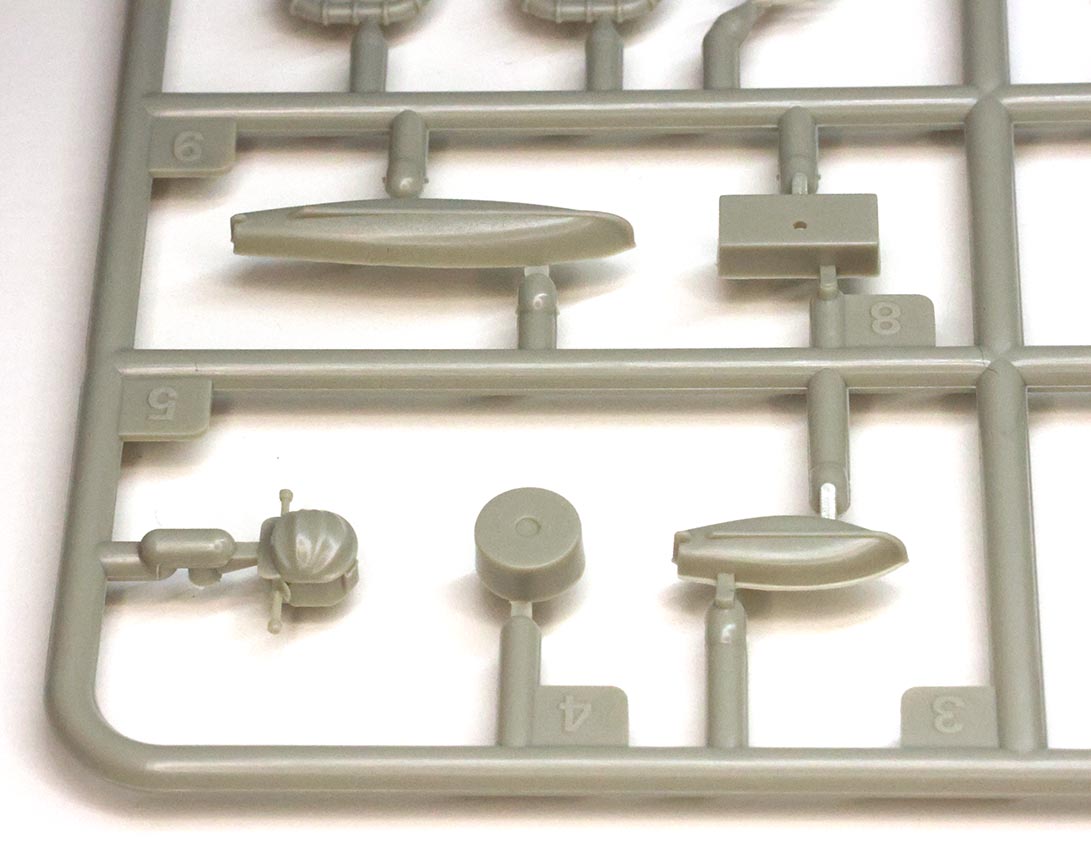
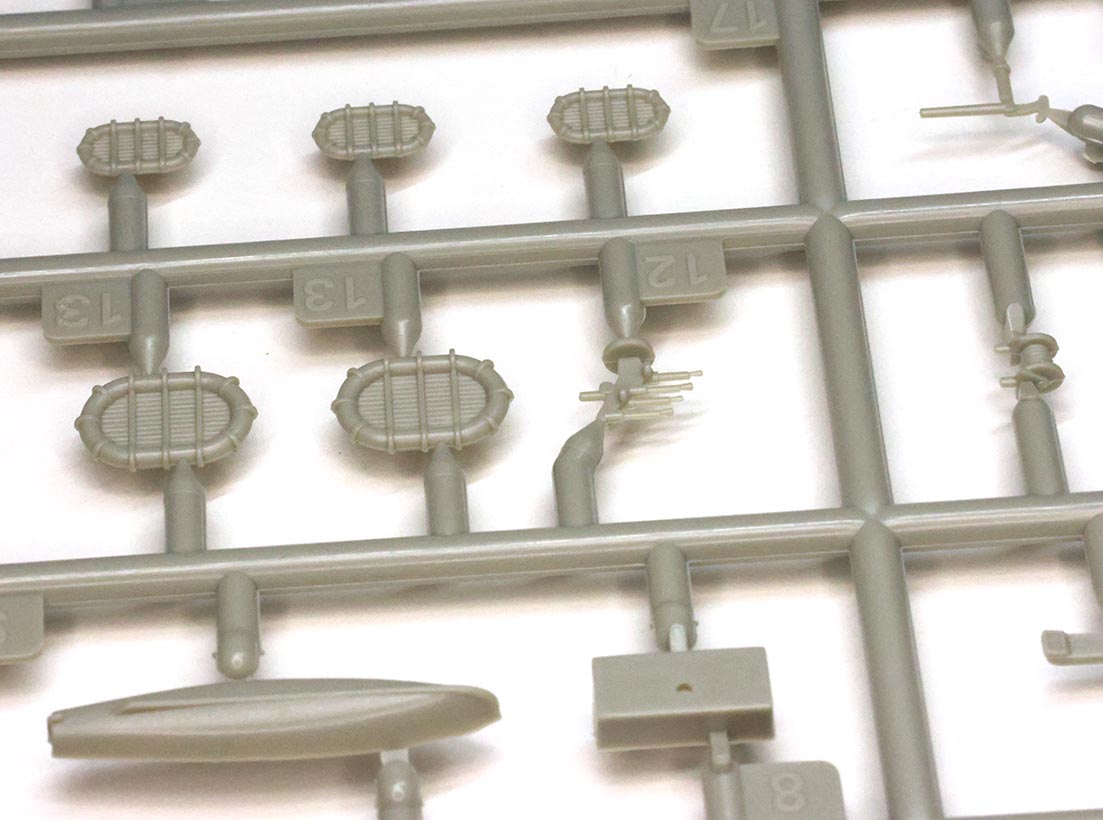
| The two "H" trees are similar to the two "D" trees in that they are together in a protective bag and partially, but not completely, wrapped in protective foam. There are a number of small details on each; such as vents, hawser reels, and booms as well as a HACS Mk III director, Hotchkiss 3-pdr and quad Vickers .50 cal machine guns. The detail on the 30' gig, 16' dinghy's, and carley floats is good, although there is a slight knocking pin mark inside near the stern on the 30' gig that might become more pronounced if one uses a wash to pick out the internal details. 4" ammo lockers for the QF guns are provided on this tree and there are knocking pin marks on the back - most of the lockers are positioned on deck such that this won't be an issue but there are few that will be visible. I think it would be easiest to use some Mr. Surfacer to fill the depressions and sand the backs while still on the parts tree before removing them given the size of the parts and size of the connection gate. | |||||||||||||||||||||||||
|
|||||||||||||||||||||||||
| SPRUE K Shelter deck, Conning Tower Superstructure Deck |
|||||||||||||||||||||||||
|
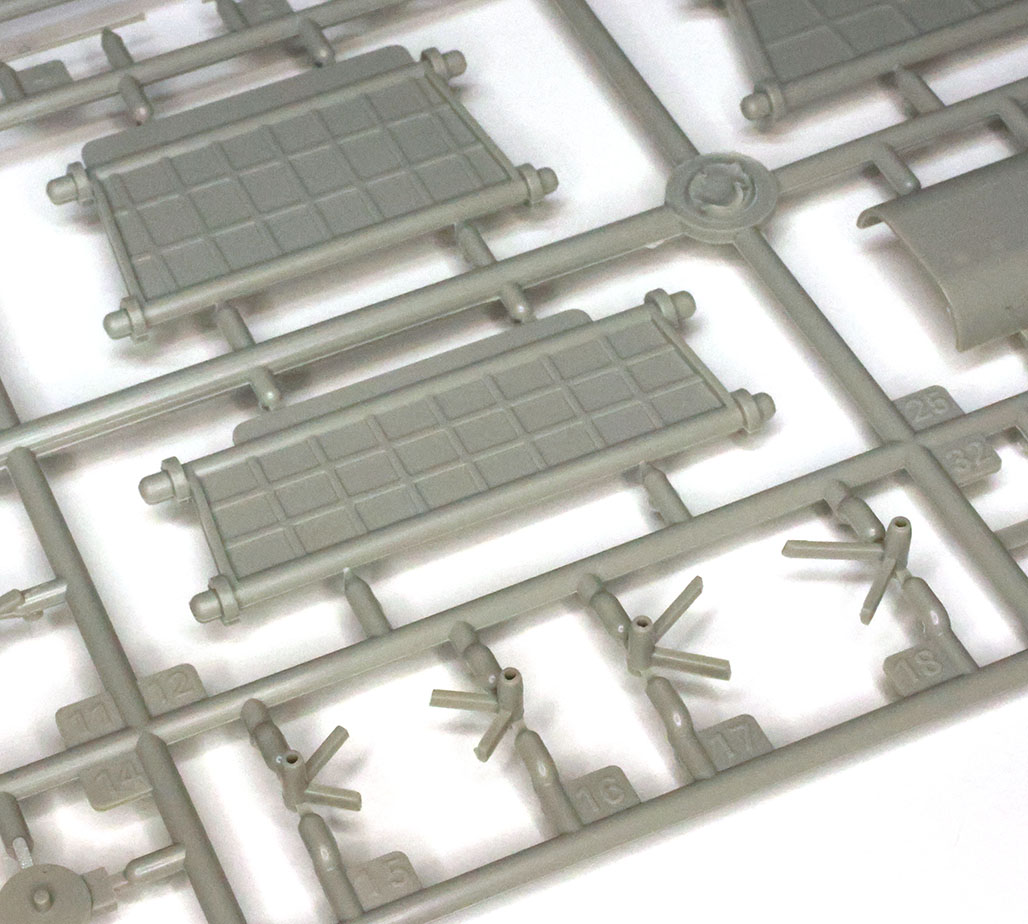
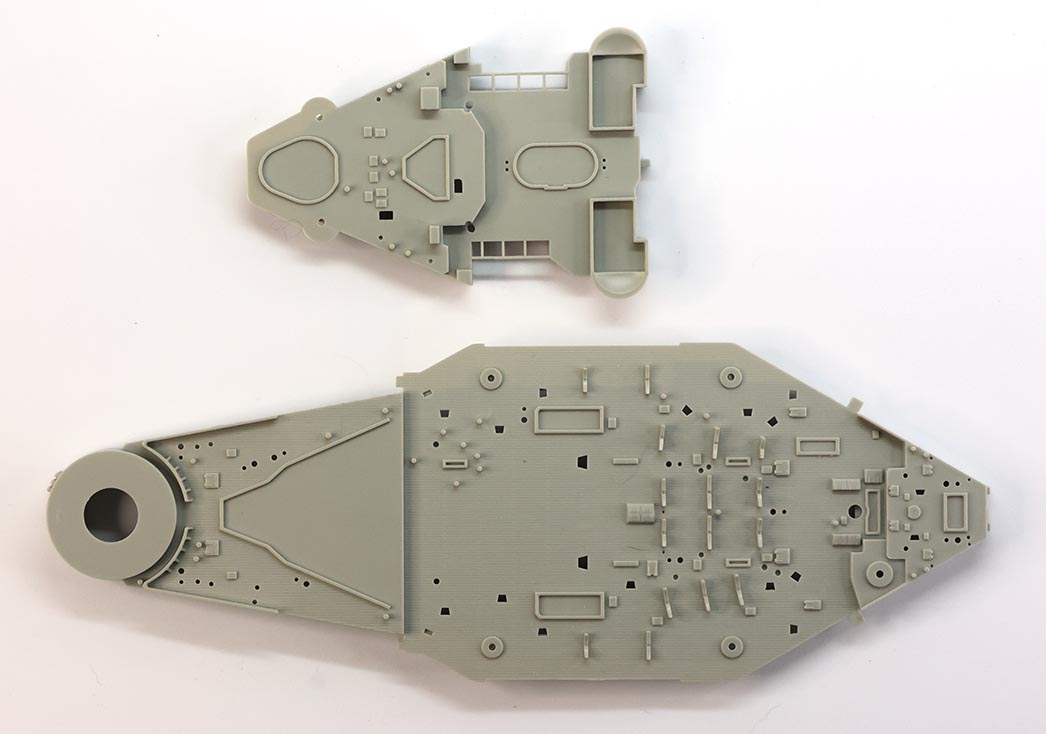
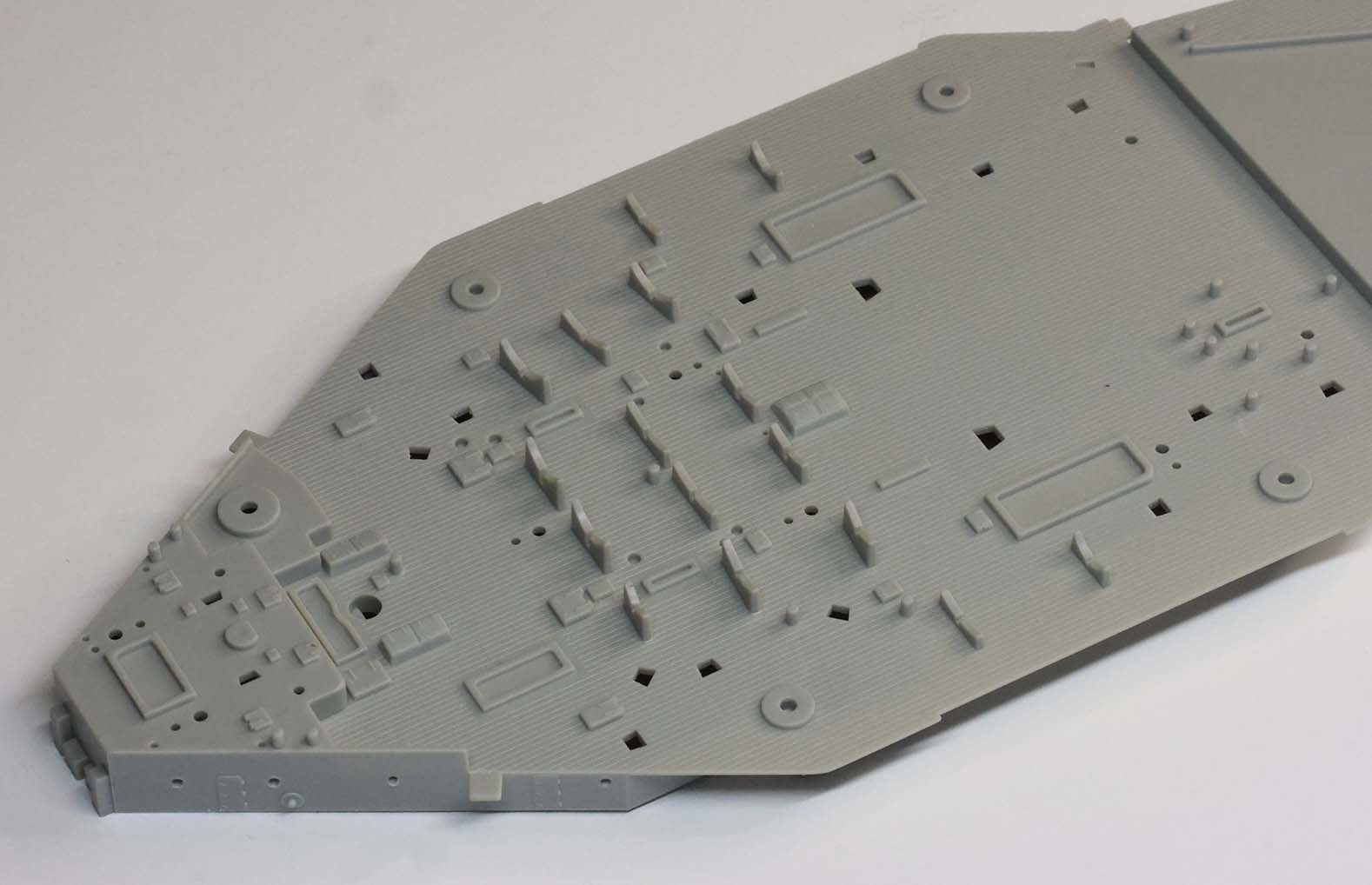
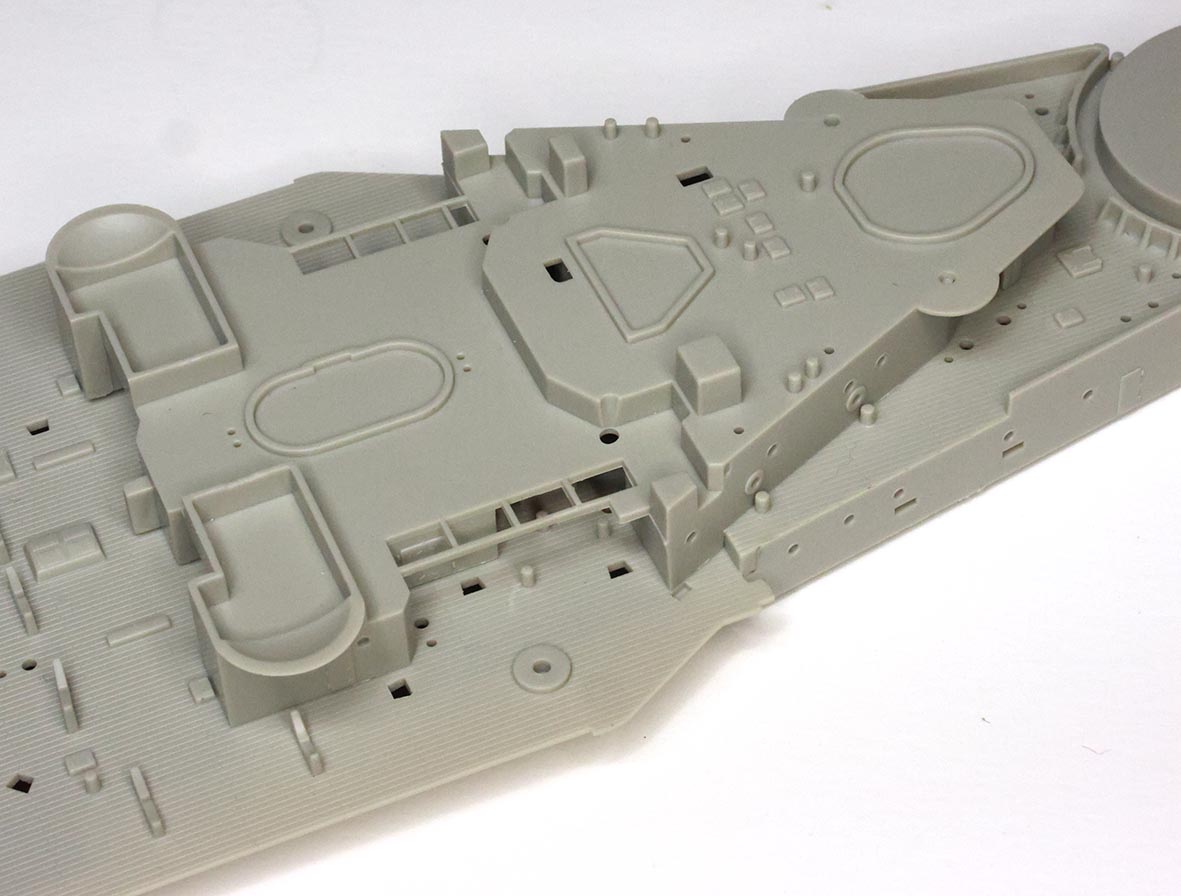
There are only two parts on "K" tree and they were both removed from the tree in a very rough and pronounced (absolutely no damage to the parts, just not close to the parts) cut and wrapped together well in foam sheet. The larger piece is the shelter deck from B barbette aft and the smaller is the lower level of the superstructure (titled the conning tower platform) that sits on the shelter deck. The sprue gates left from the cut are on the bottom of the pieces and are easily dealt with if you have sprue nippers, a razor saw, or coarse sanding sticks or files. Once cleaned of the extra plastic the pieces fit very well against each other and the Forecastle deck piece (Q2) below. The Conning tower platform level is rendered as piece K1 and is slide molded to offer a fairly complex shape with minimal construction. There are a couple of angled bulkheads that result in a slightly oval porthole but the only two that I would characterize as "obvious" are under an overhanging platform in shadow and not really noticeable. The Shelter deck piece K2 has two sections; a slightly higher section behind B turret that supports the main superstructure tower and a slight lower section with the 4" quick-fire gun mounts and ships boats. This area is rendered with a planked wooden deck when it was in fact metal and should be mostly smooth (there were some radial metal strips welded or otherwise fastened to the decks around the 4" guns to provide some extra traction). This may be problematic to fix as the part is fairly busy with details including some boat cradles, vents, and alignment lines for various separate pieces of the super structure. While nicely done, in this case they may prove tedious to deal with while filling the engraved deck planking for those that choose to do so. |
|||||||||||||||||||||||||
|
|||||||||||||||||||||||||
| SPRUE L | |||||||||||||||||||||||||
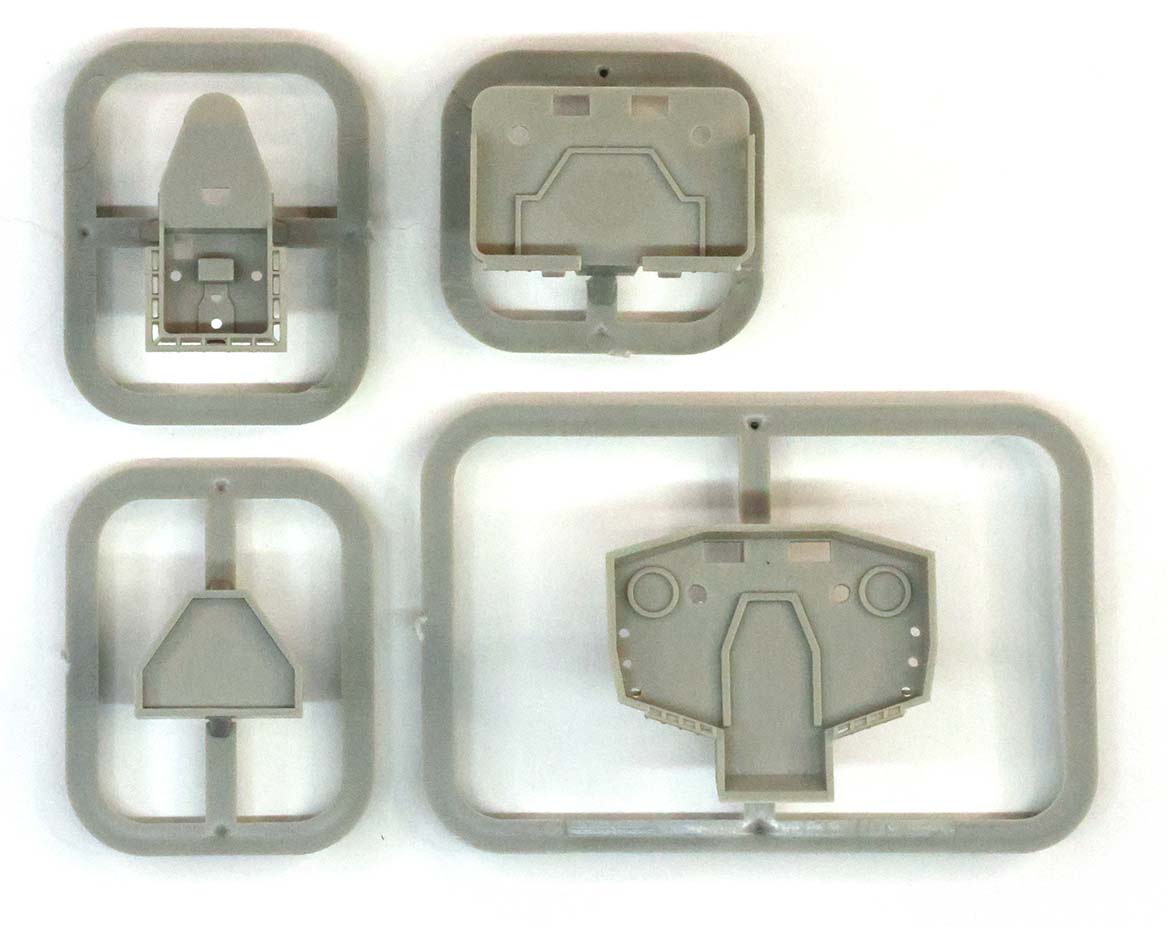
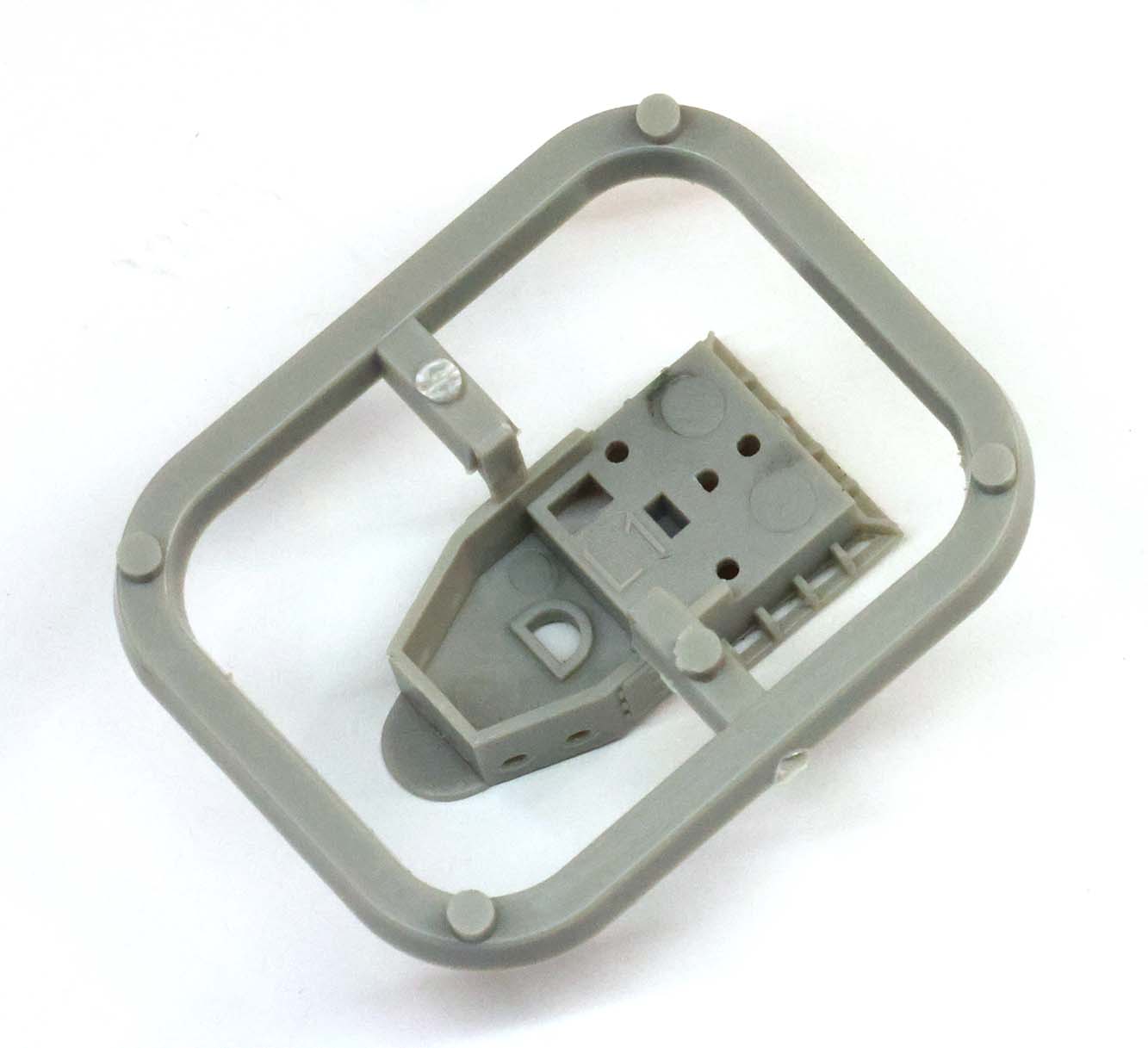
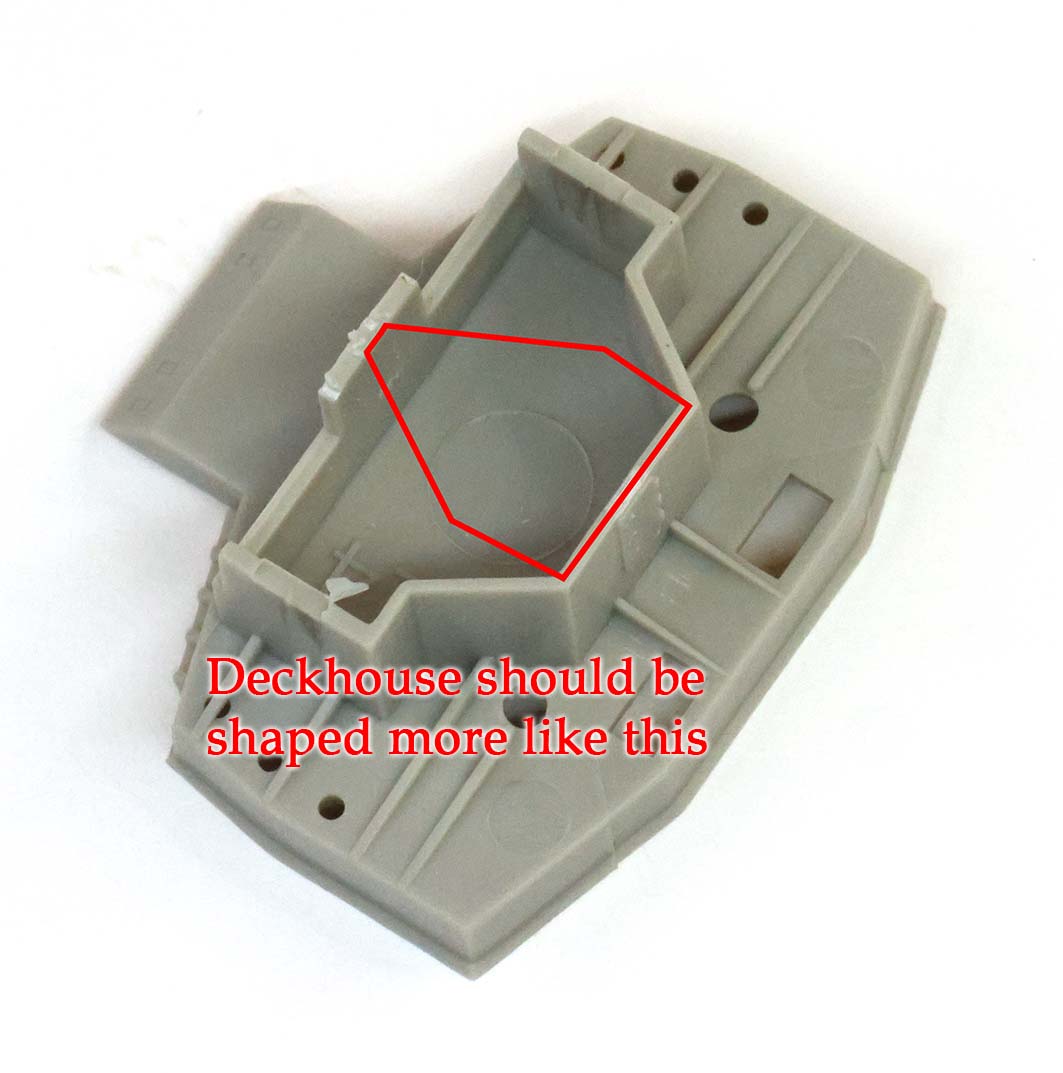
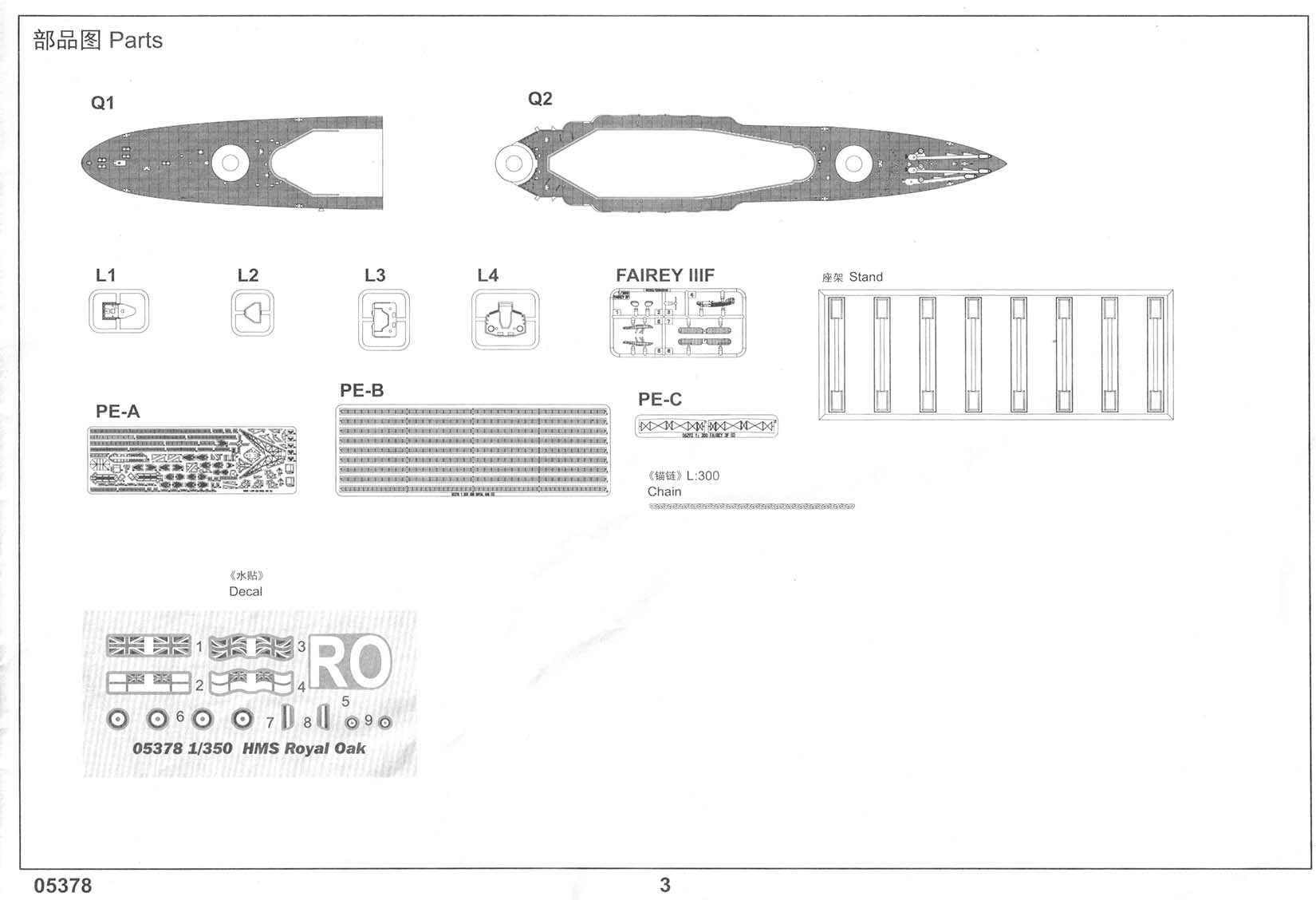
| The four individual pieces that make up the L "Tree" comprise the stack of platforms underneath the forward tripod. The pieces bounce around in order a bit, with L1 representing the top level Plotting Office enclosure & compass platform a half level above the Upper Bridge is piece L4. On my copy there were some slightly raised knocking pin marks on the bottom of the compass platform area that could affect fit to piece L4 below it, but sanding these down should be short work. The wind baffles on this level are hollow and completely in plastic - while not as thin as photo-etch they look decent. There is a raised spot underneath the venturi baffles where Royal Oak's crest was mounted that is nicely done, however there is no decal provided for the emblem itself. L4 below this level is the Upper Bridge platform and the structure for the lower bridge below. The lower bridge structure on the bottom of L4 is incorrect as far as I can tell from plans sourced from the National Maritime Museum in Greenwich. Trumpeter fills in more of the space behind a pair of windowed bulkheads than the plans show. This may not matter to most and will be mostly hidden if one installs the missing 9' range finders that are almost immediately outboard this extra structure from aftermarket sources. The structure in this area is all flat surfaces with simple edges so it should not be difficult to cut away and replace the incorrect bulkheads with sheet styrene for correct shapes. | |||||||||||||||||||||||||
|
|||||||||||||||||||||||||
| SPRUE Q | |||||||||||||||||||||||||
|
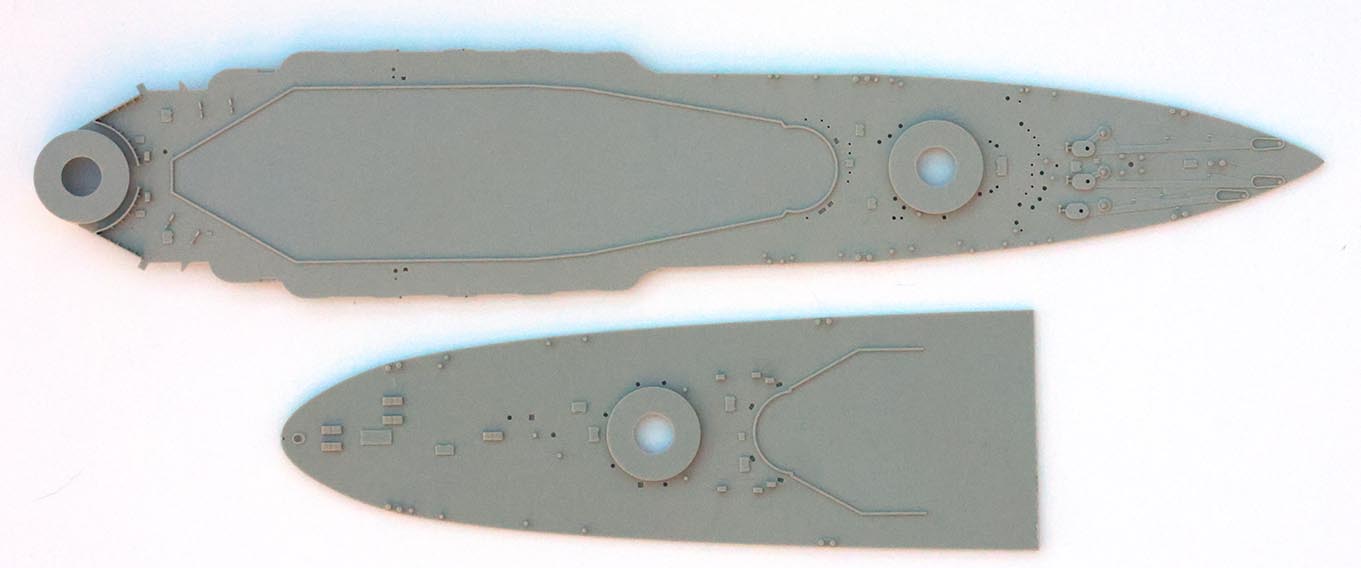
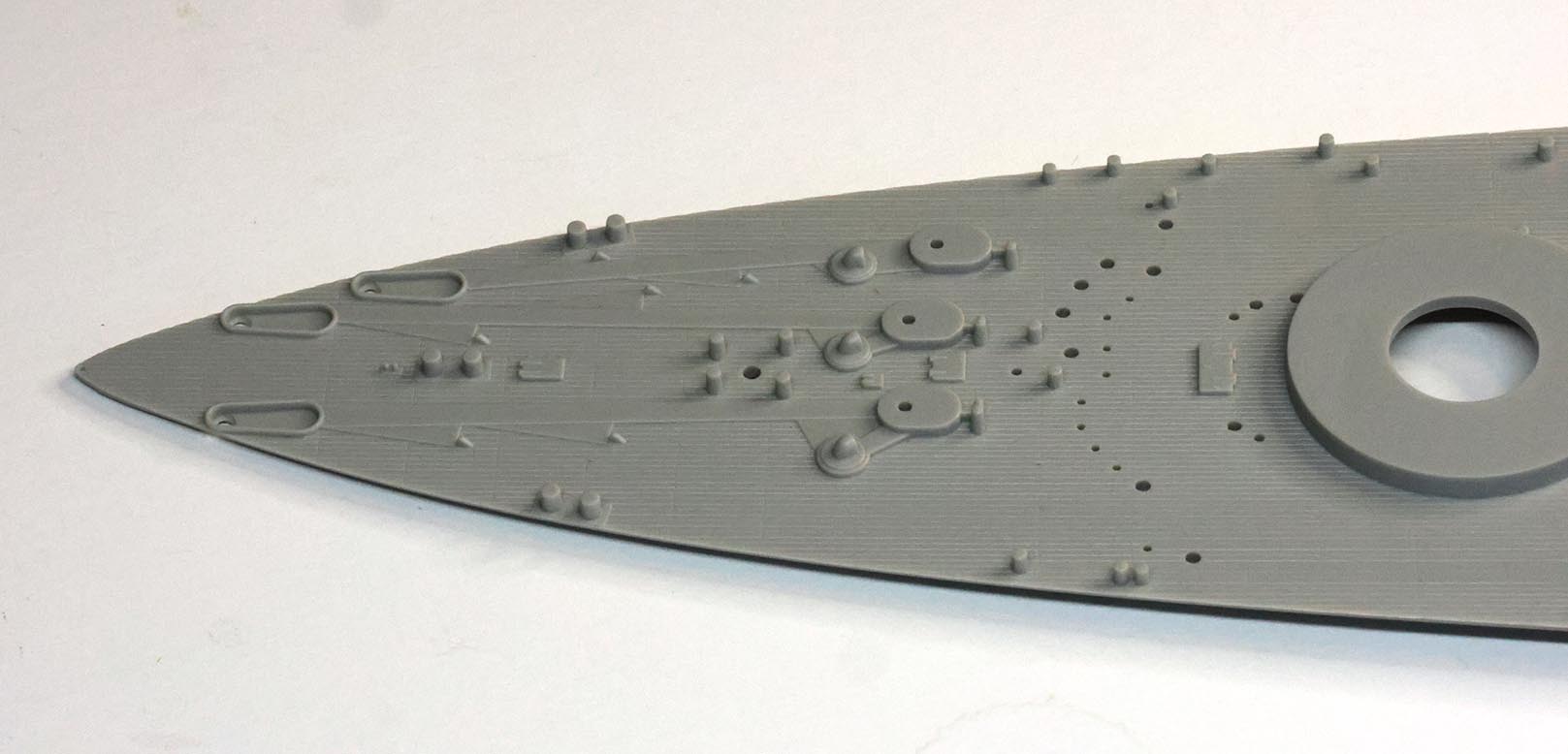
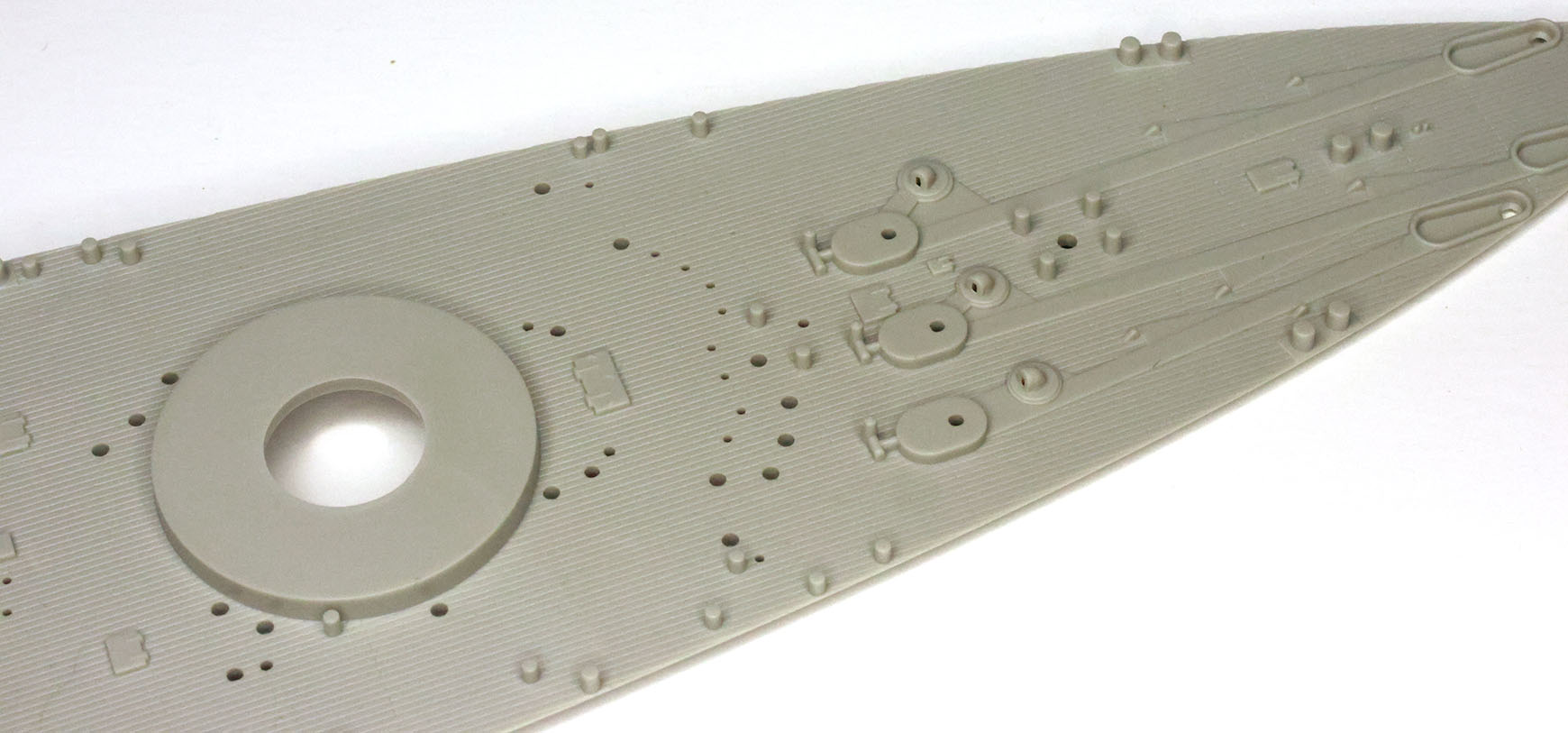
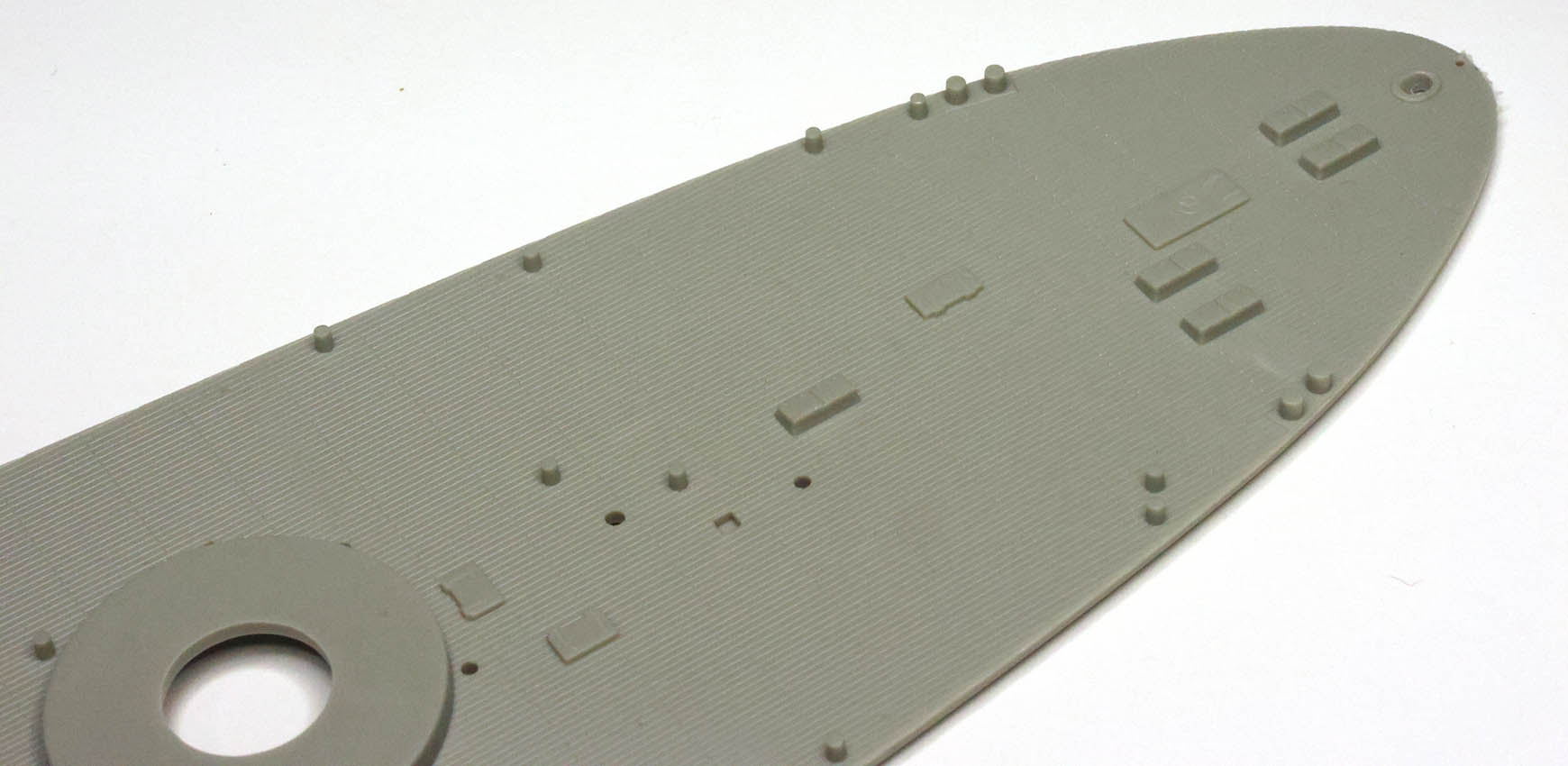
The final two major plastic pieces to discuss are Q1 and Q2, which are the Upper Deck and Forecastle Deck, Respectively. To avoid confusion it is worth noting that the "upper deck" is actually the deck below the forecastle deck, and might be referred to as the "aft deck" by some. Planking is fine and the joints offset (every other plank - I have no plan that shows what this ought to be). Hatches and deck details match the National Maritime Plans fairly well, althought there are there are four hatches at the aft end of the forecastle deck which should be vents (two of them can be easily built with some quarter round styrene). There is no deck camber in these pieces, which Royal Oak had (as did the shelter deck, rendered as piece K2 as discussed above) according to plans. The anchor chain chafing plates do not match those in the Royal Navy plans - however the plans lack any sort of detail on planking and I haven't found any clear photos that show what the chafing plates fully looked like and the kit may be close to correct. |
|||||||||||||||||||||||||
|
|||||||||||||||||||||||||
| FAIREY IIIF | |||||||||||||||||||||||||
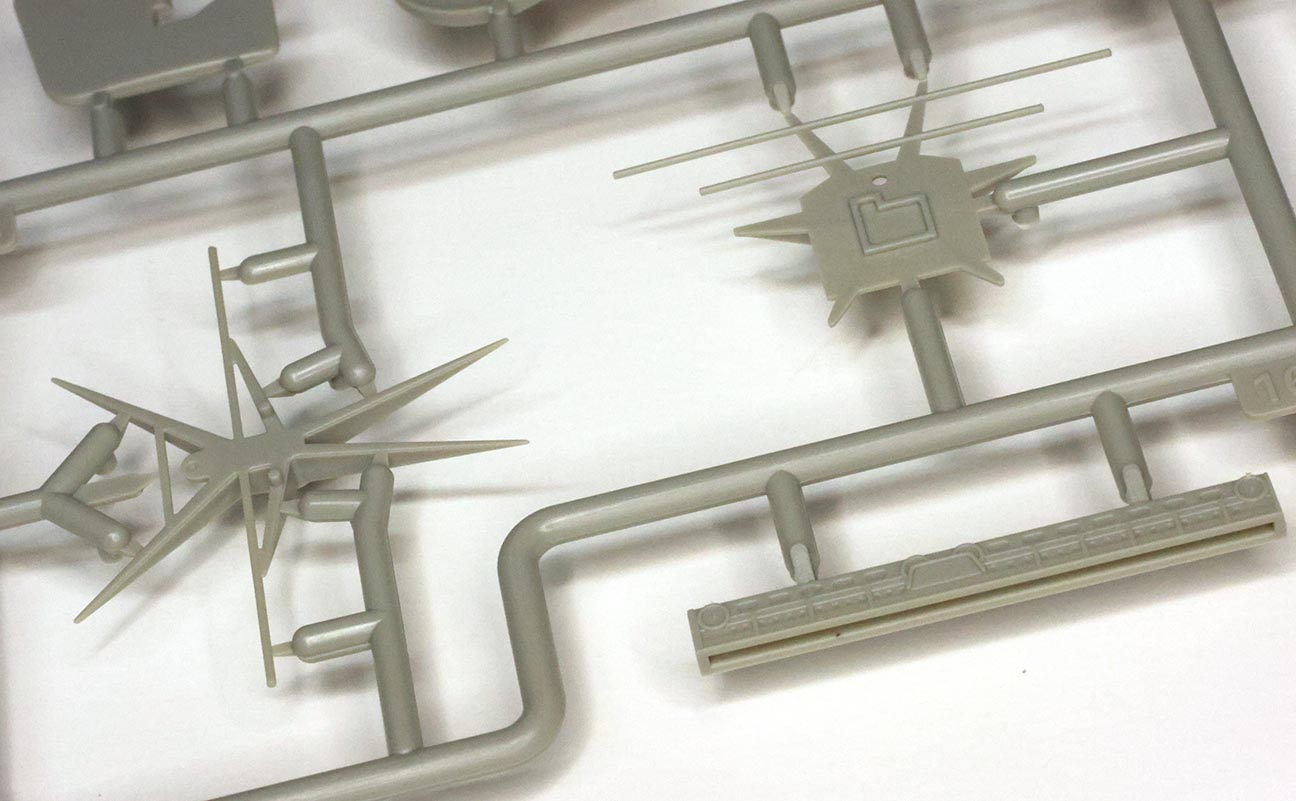
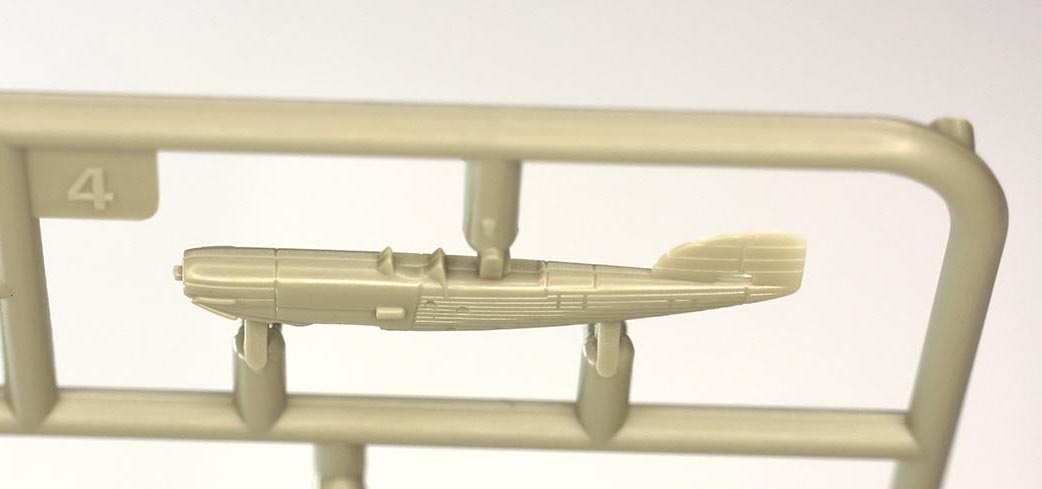
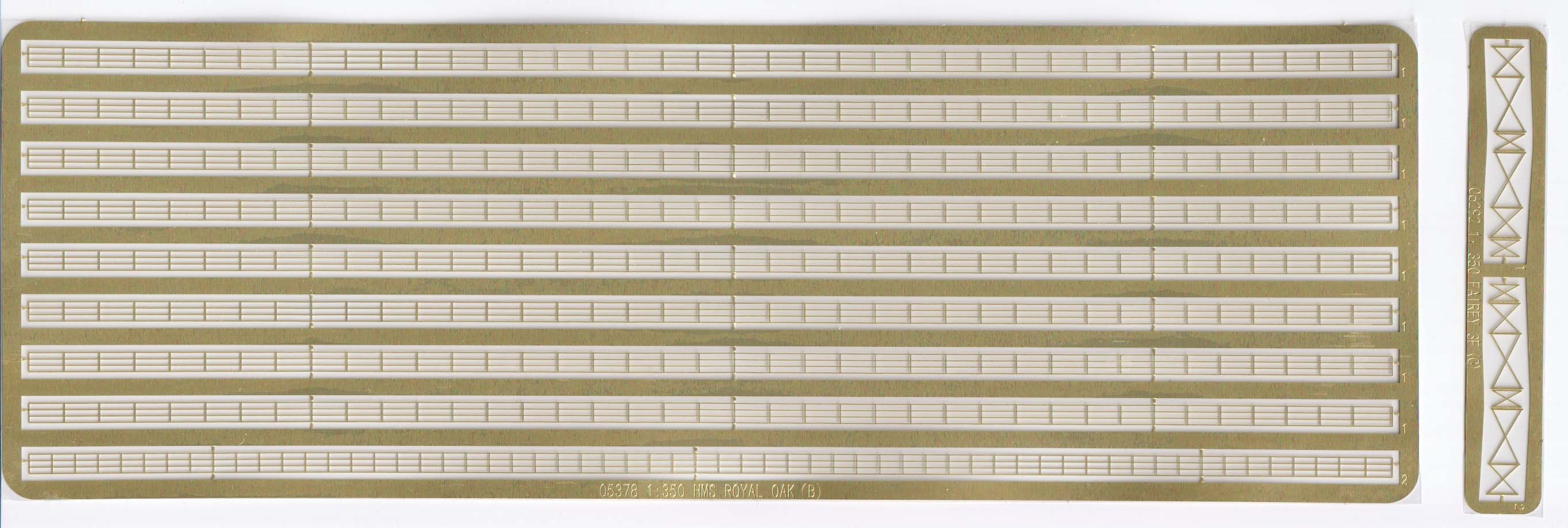
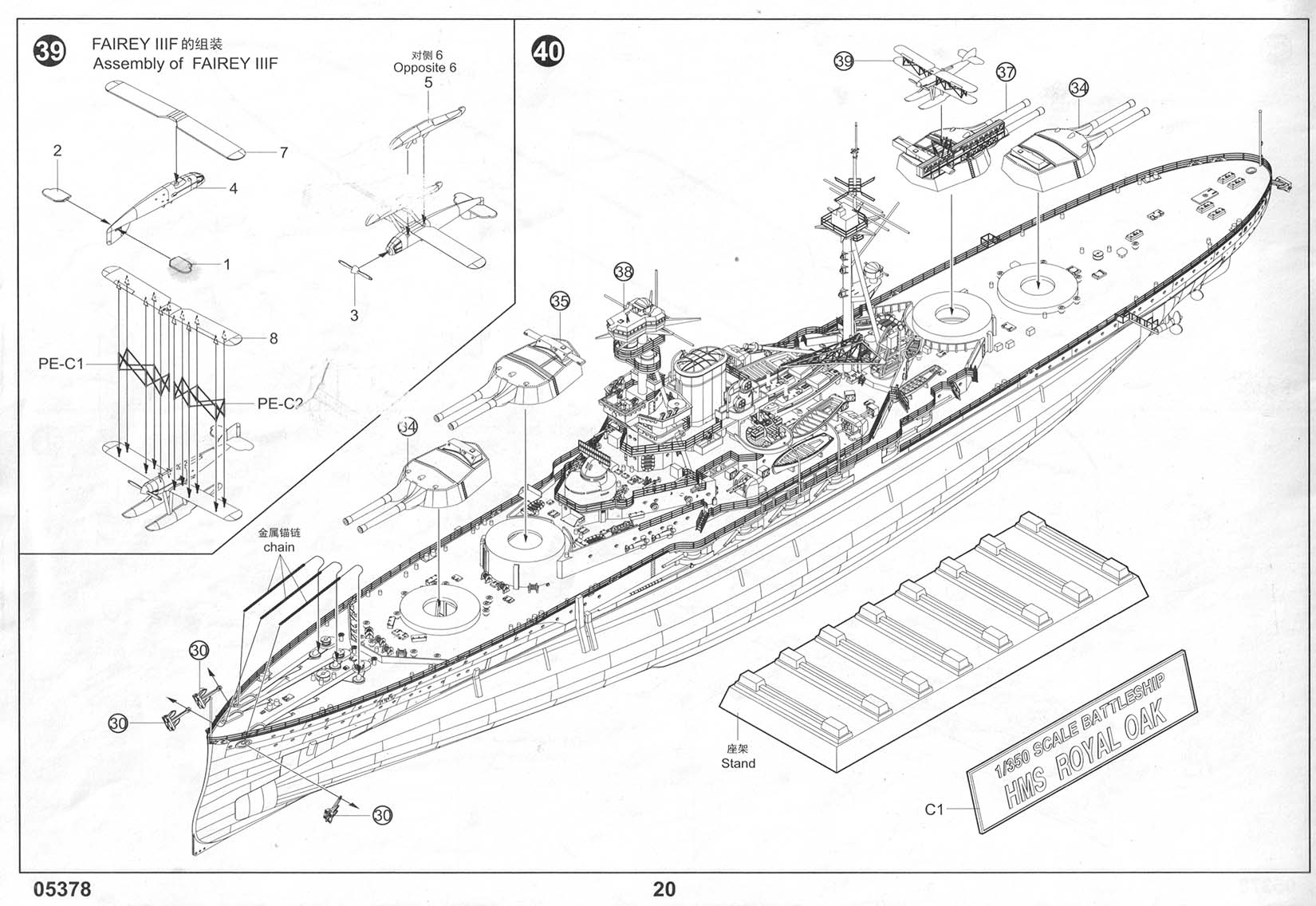
| There is a single fret for a Fairey IIIF as carried on a catapult on top of X Turret. The biplane is molded in six plastic pieces with wing braces on a separate small photo-etch strip. Royal Oak had landed her Fairey IIIF before the sinking and it was not present when she was sunk, but the inclusion of one is an obvious choice and will be handy for those wanting to depict an earlier time frame. | |||||||||||||||||||||||||
|
|||||||||||||||||||||||||
| PHOTO-ETCH FRETS | |||||||||||||||||||||||||
|
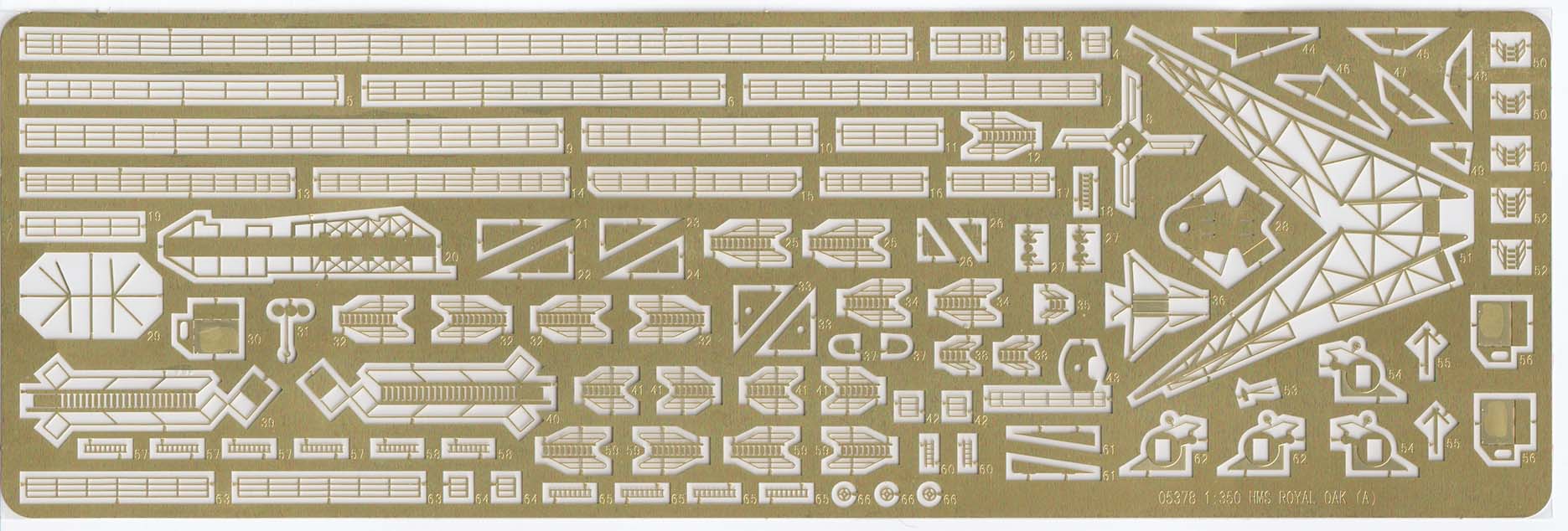
There are three photo-etch frets included in the kit, providing all of the deck-edge stanchion required. PE-A has individualized pieces, such as the inclined ladders, crane truss, and pre-sized pieces for certain platforms. PE-B has eight lengths of a standard three-bar railing as well as one section of shorter three-bar railing marked as "PE-B2" that I can find no reference to in the instructions. It's possible that this is meant for the boat deck area on the shelter deck level, but I am not sure. Regardless, there should be sections of two-bar railings for the conning tower level (including the separate pom-pom platforms), the two director platforms on the forward mast, and the incinerator house on the shelter deck immediately aft of the funnel (in between the Pom-Pom platforms but a level down, more or less). This is an OK basic set but leaves room for third parties to step in with more complete sets. |
|||||||||||||||||||||||||
|
|||||||||||||||||||||||||
| DECAL | |||||||||||||||||||||||||
|
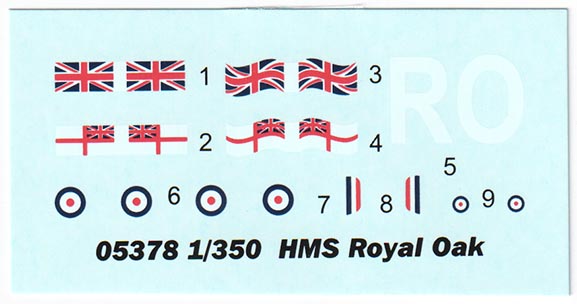
There is one small decal sheet included with the model. Included are "wavy" and straight versions of Navy Ensign and Jack, the "RO" painted on B Turret for part of Royal Oak's career, and markings for the Fairey IIIF biplane. There was a period of time in 1936-37 where three stripes in red, white, and then blue ran athwartships across B Turret and it would have been nice to have those included as the fit of the hsip is valid for this time period as well. |
|||||||||||||||||||||||||
|
|||||||||||||||||||||||||
| INSTRUCTIONS AND COLOR CHART | |||||||||||||||||||||||||
|
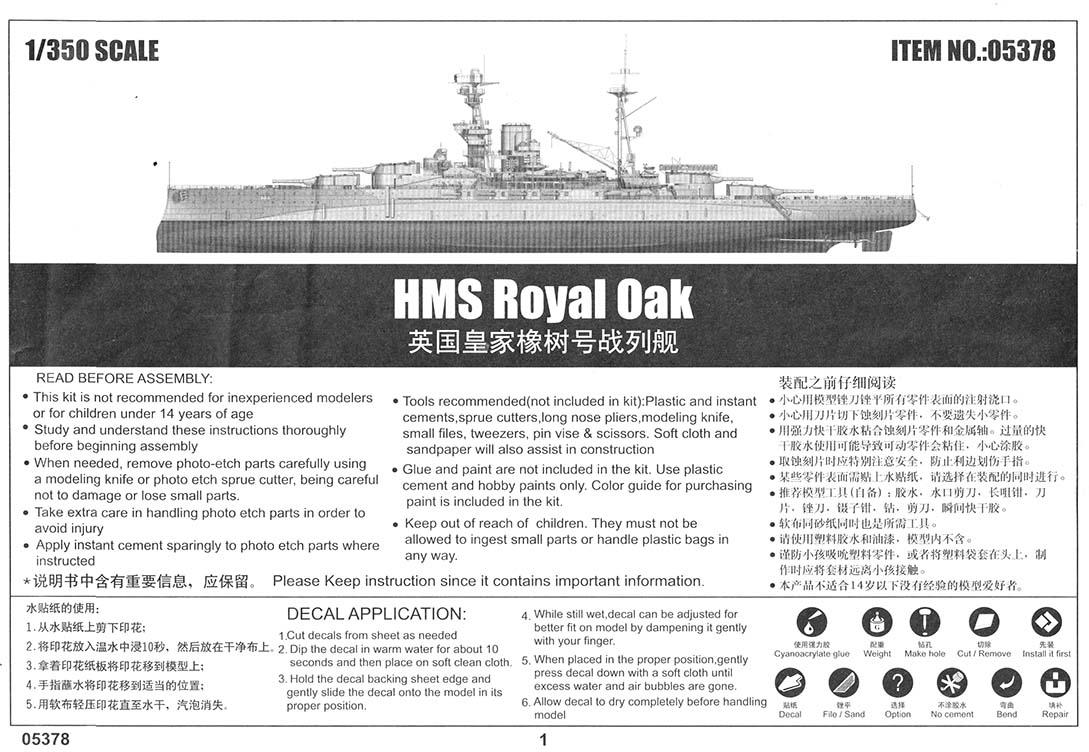
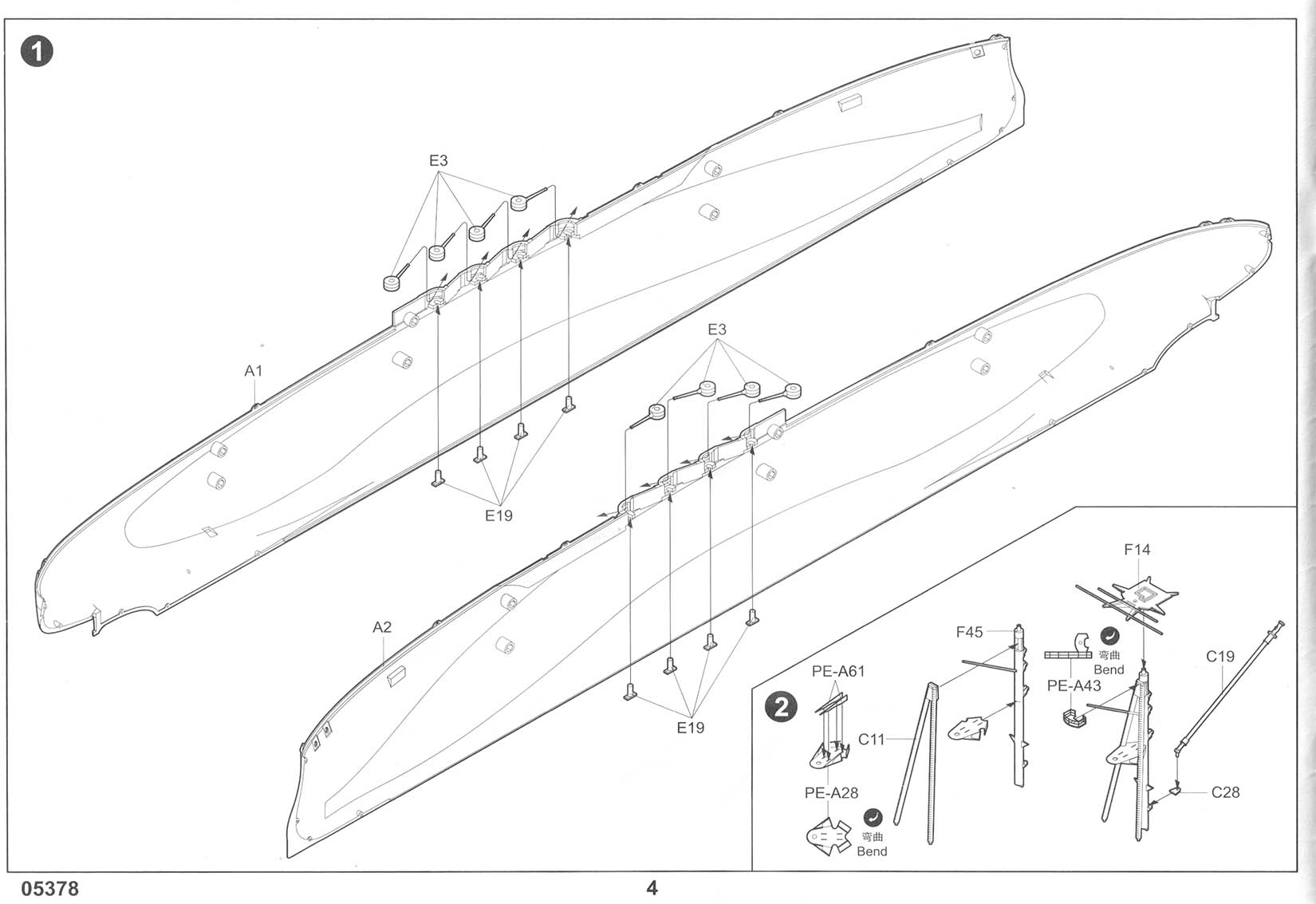
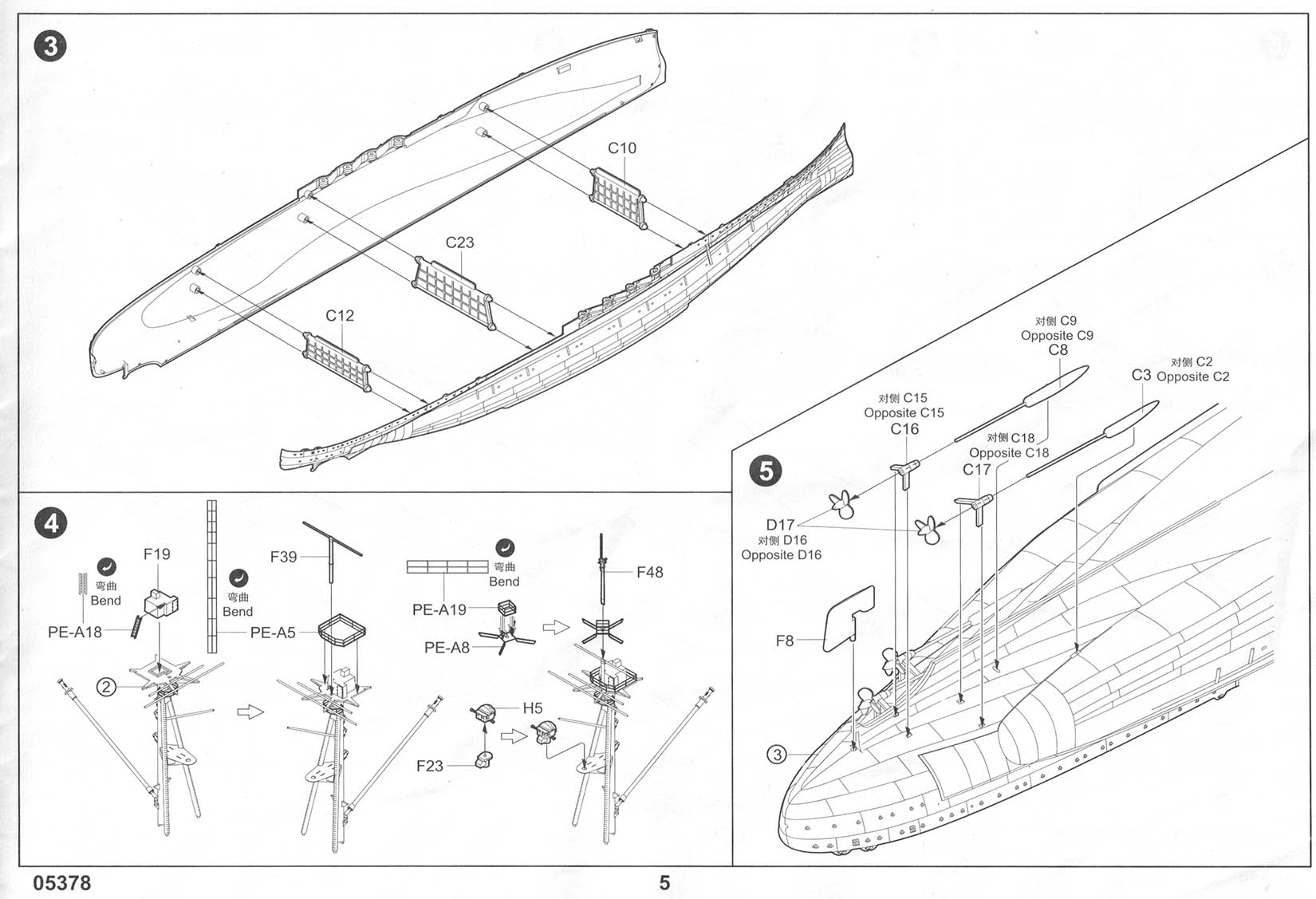
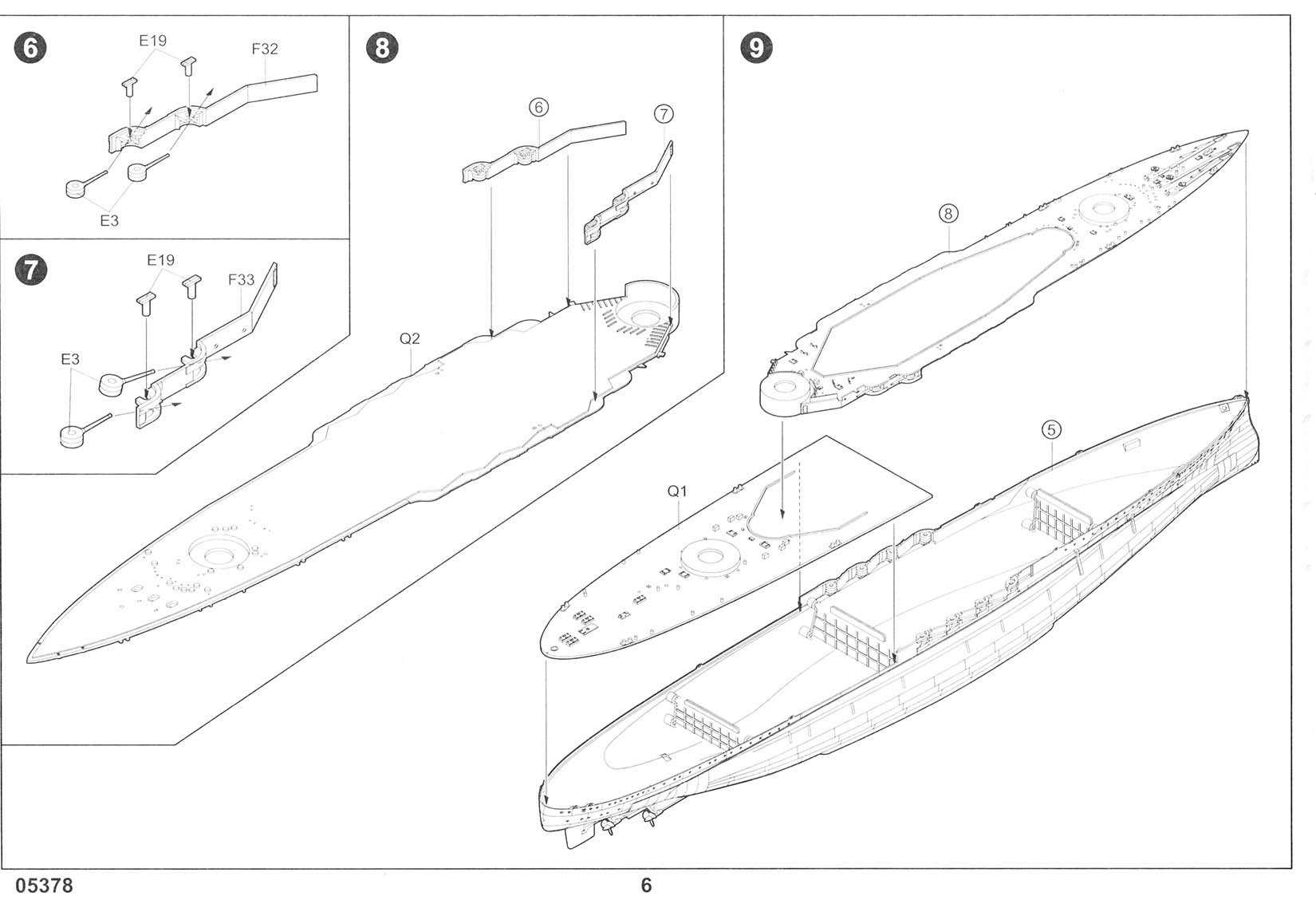
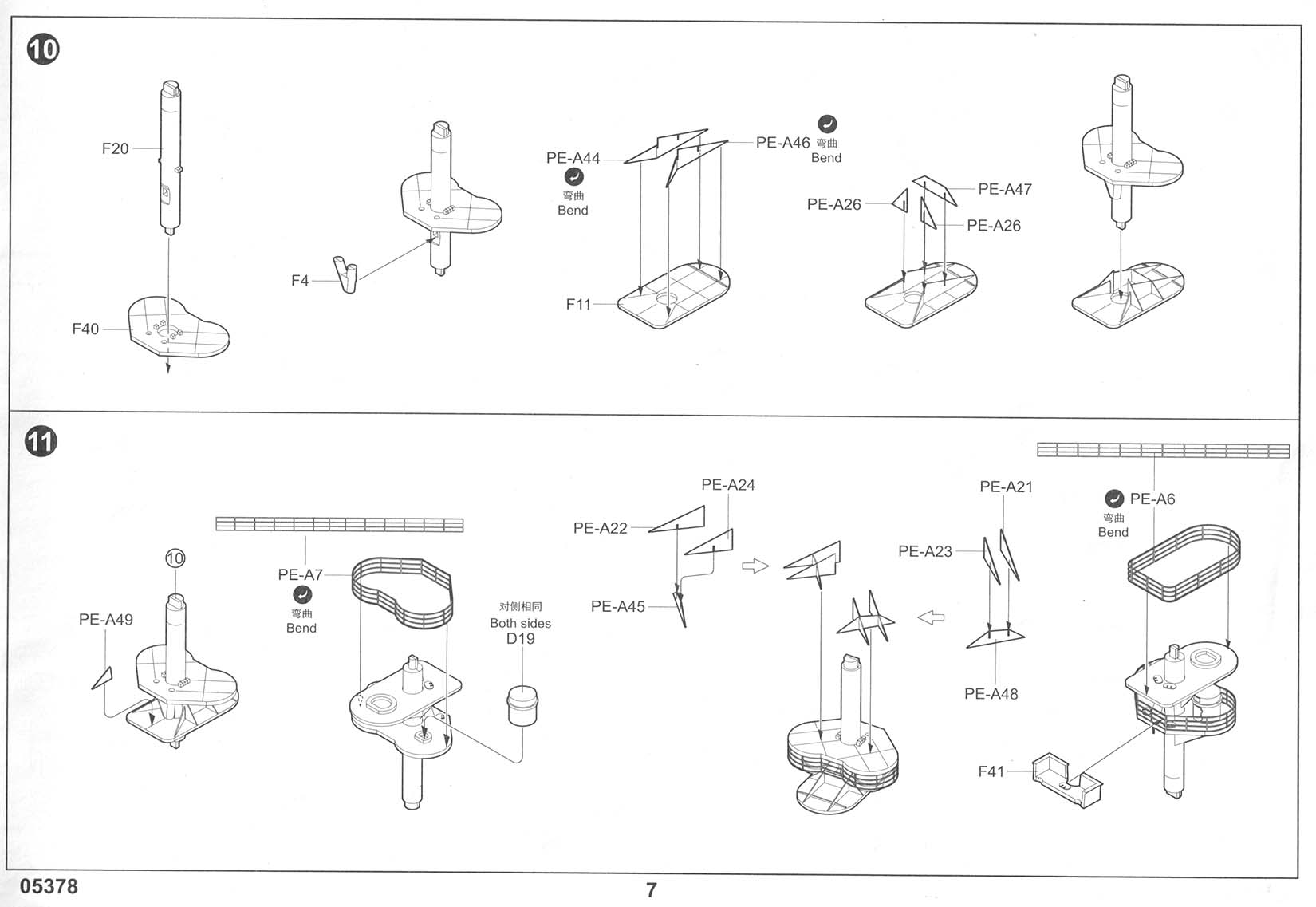
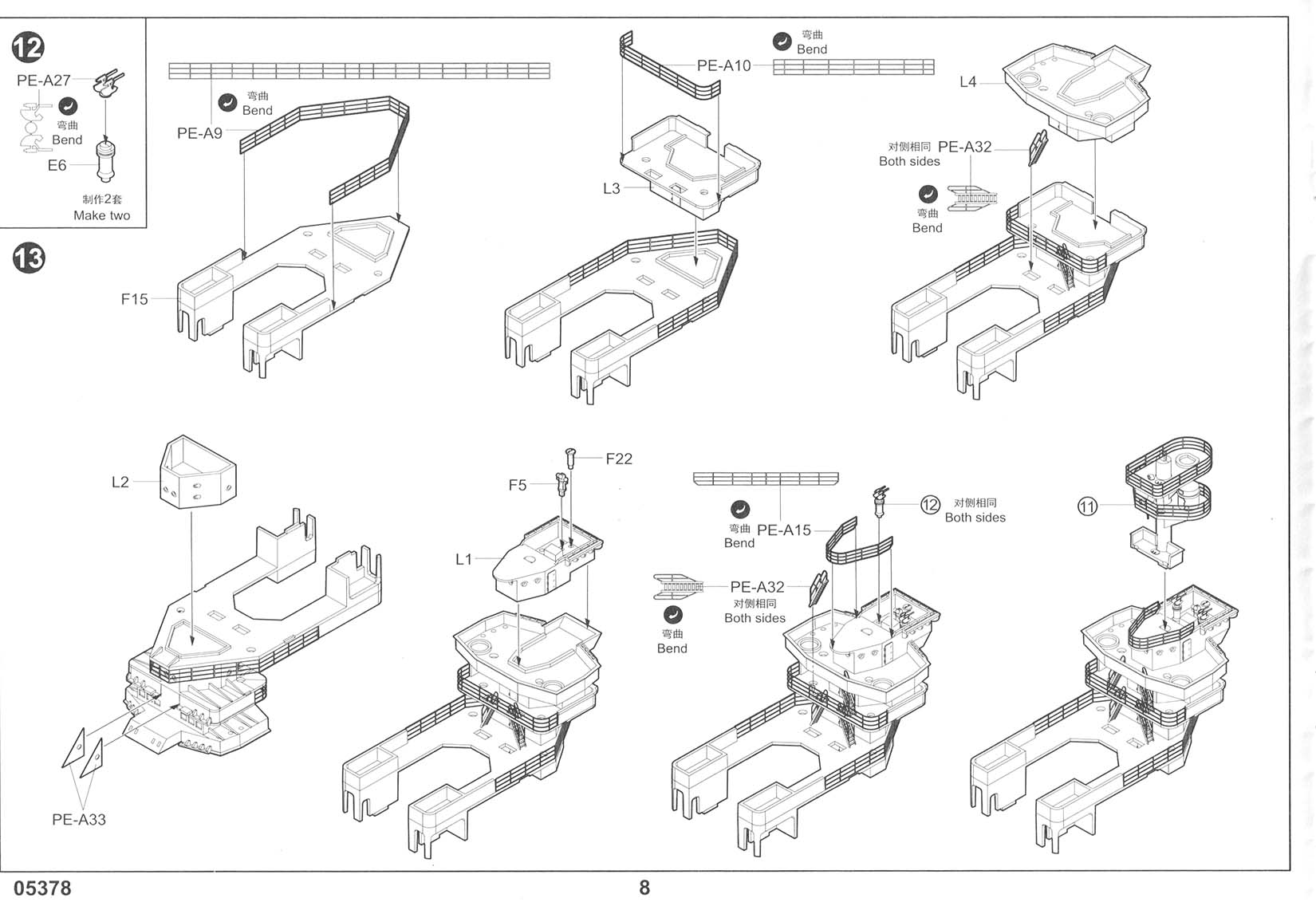
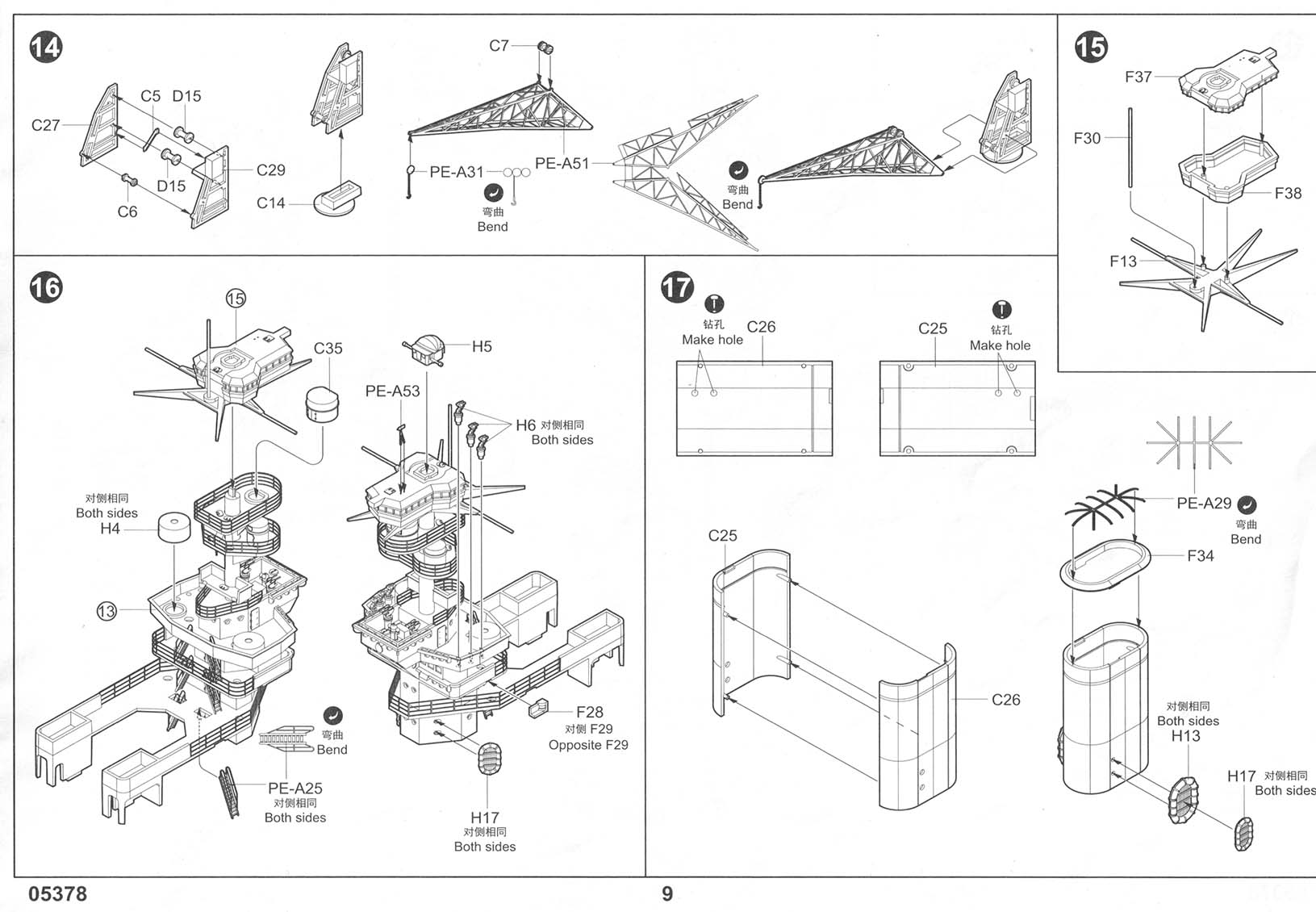
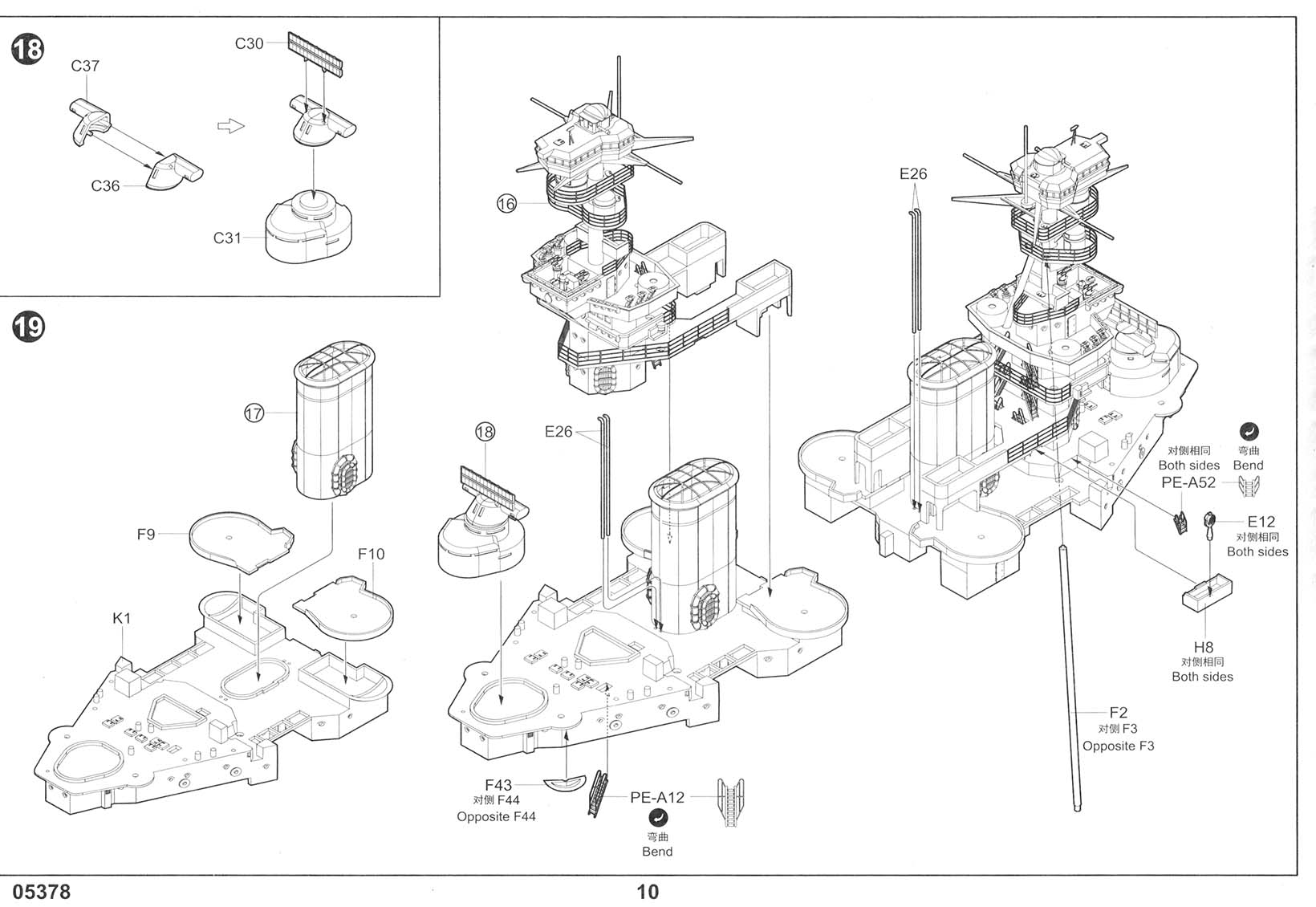
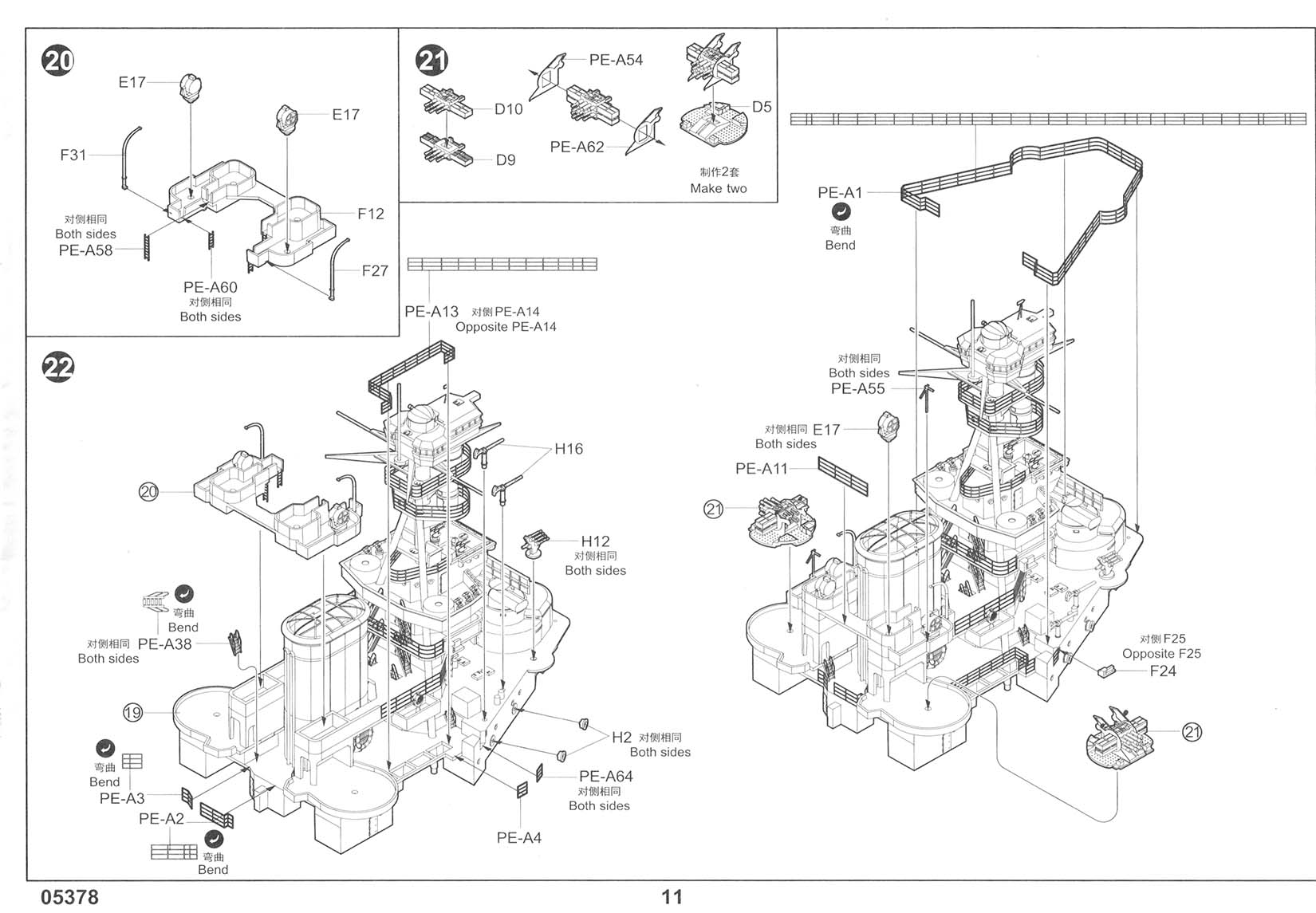
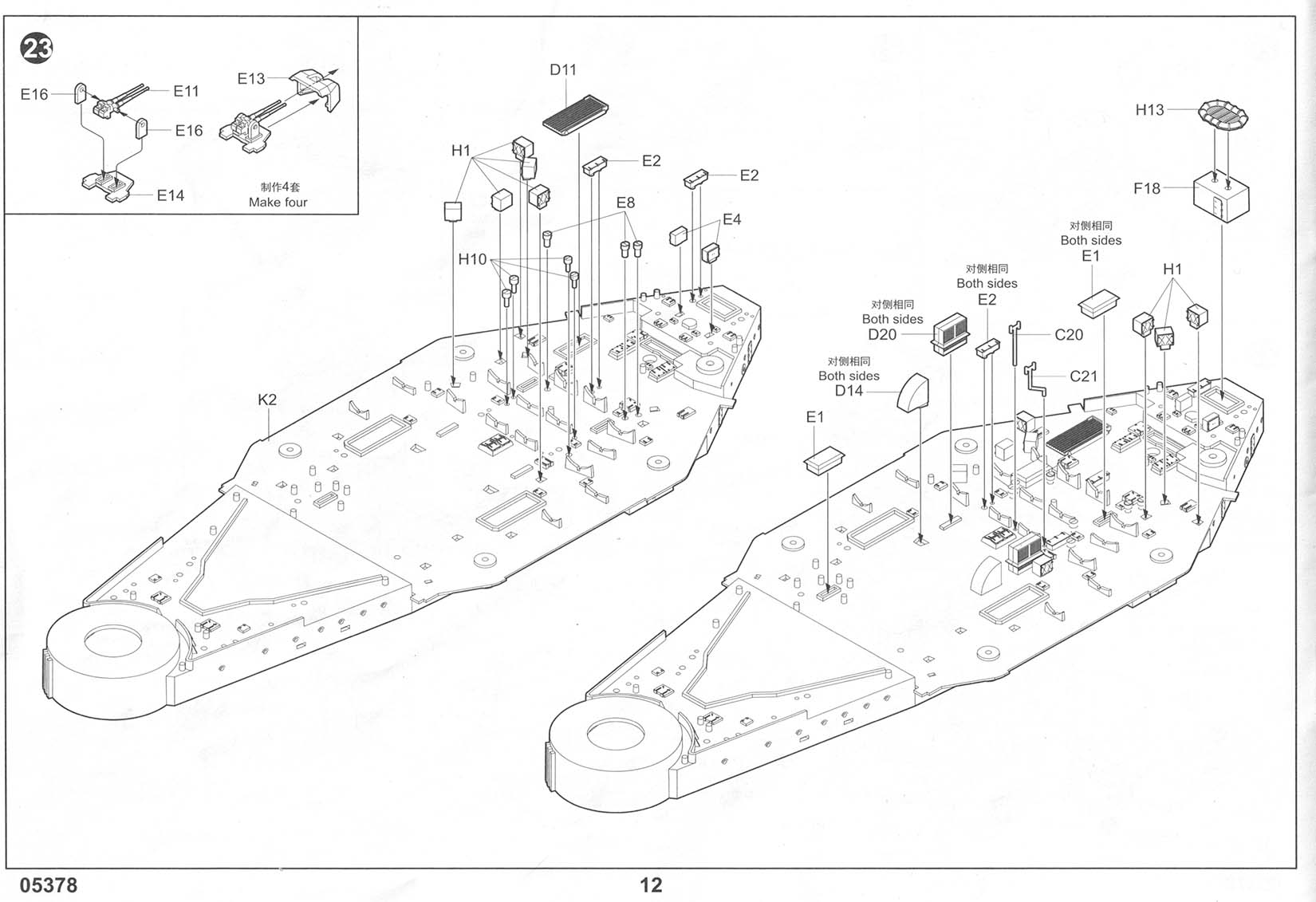
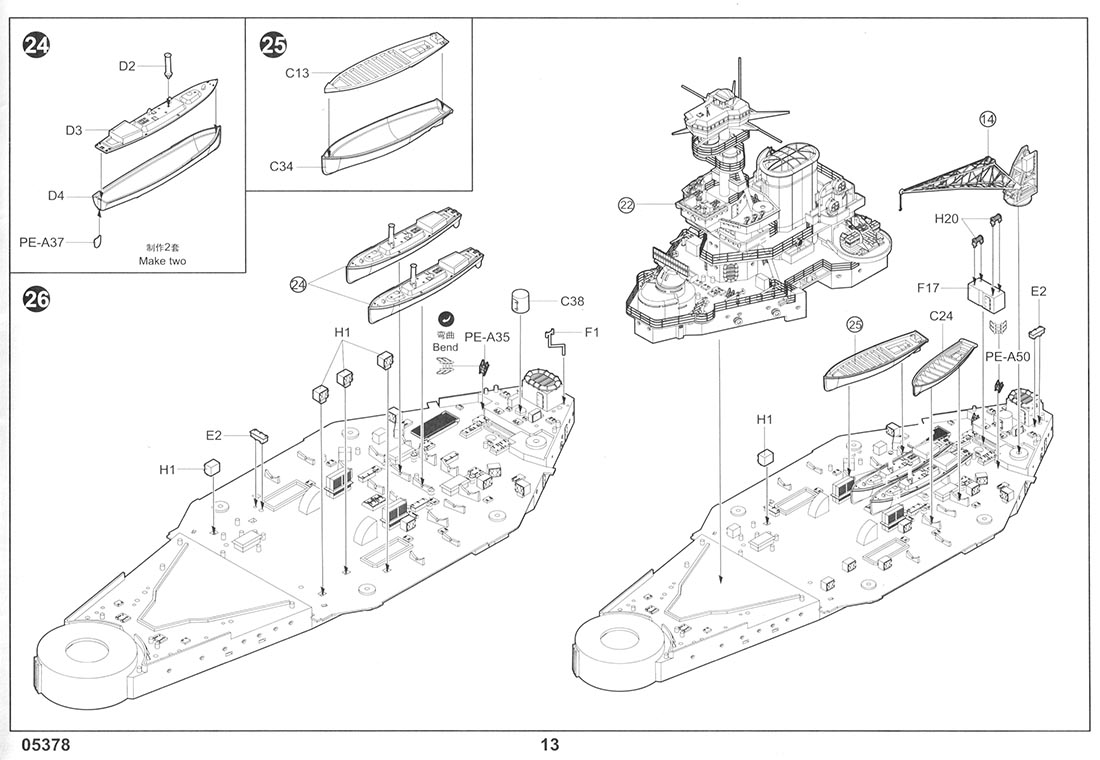
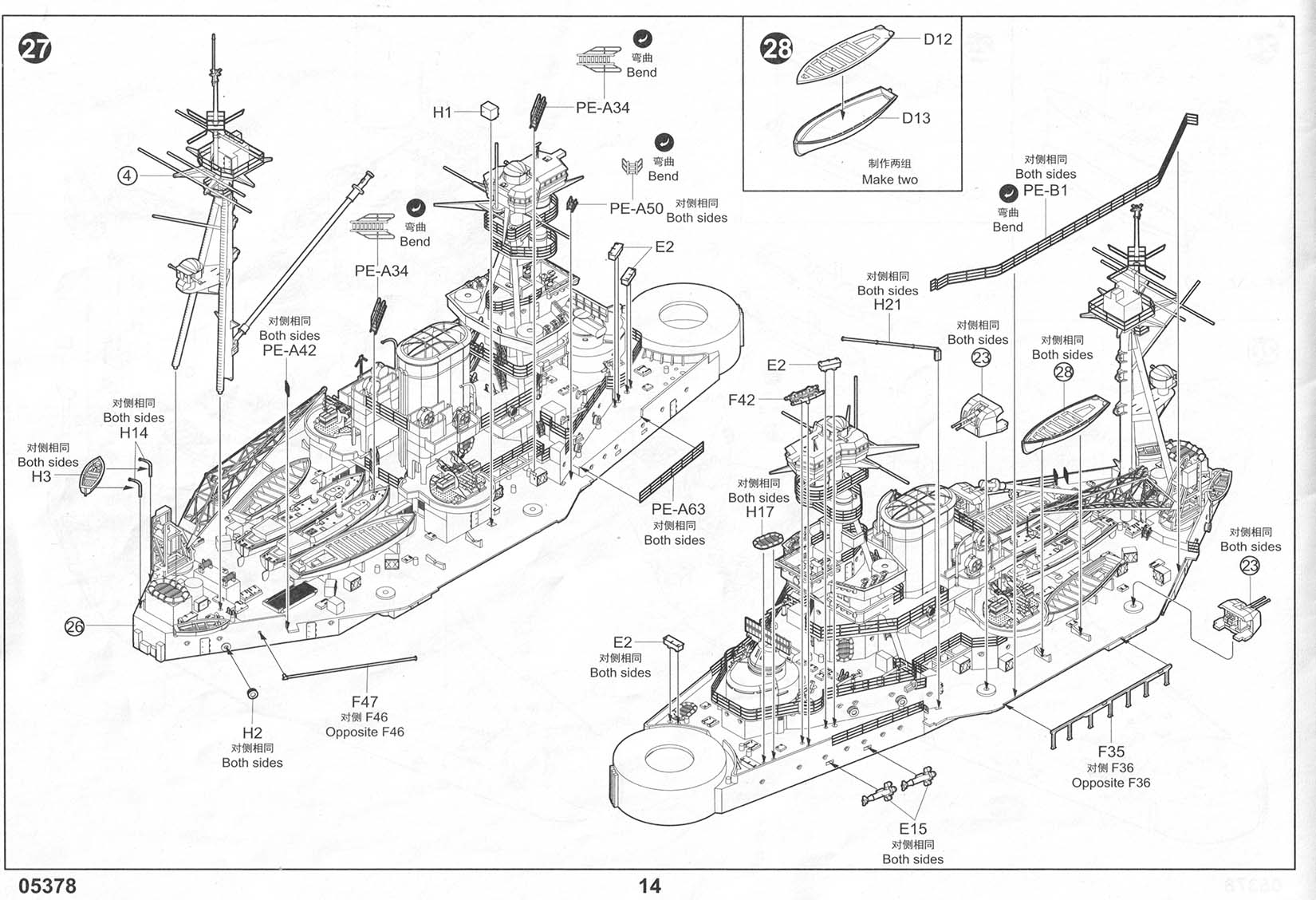
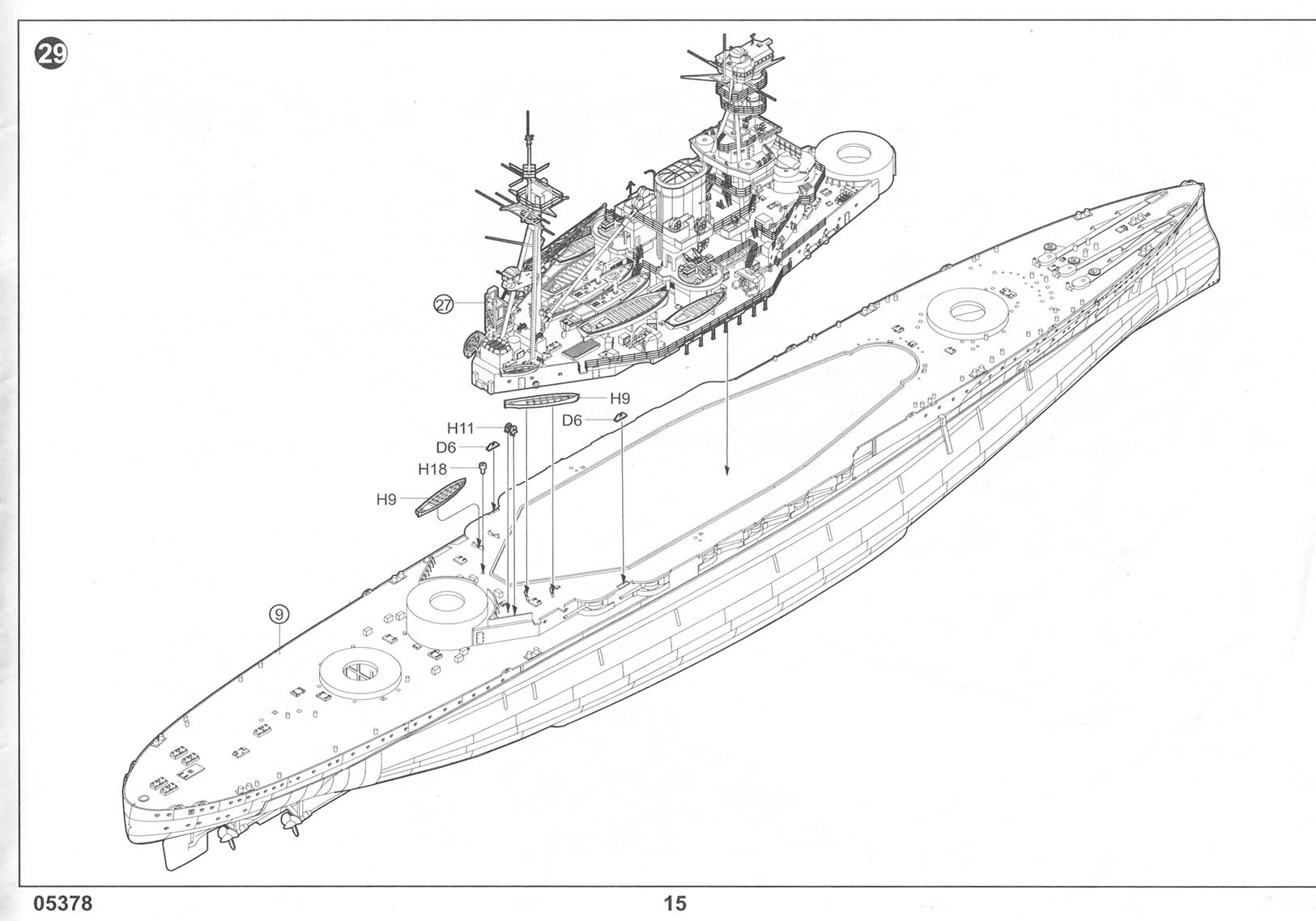
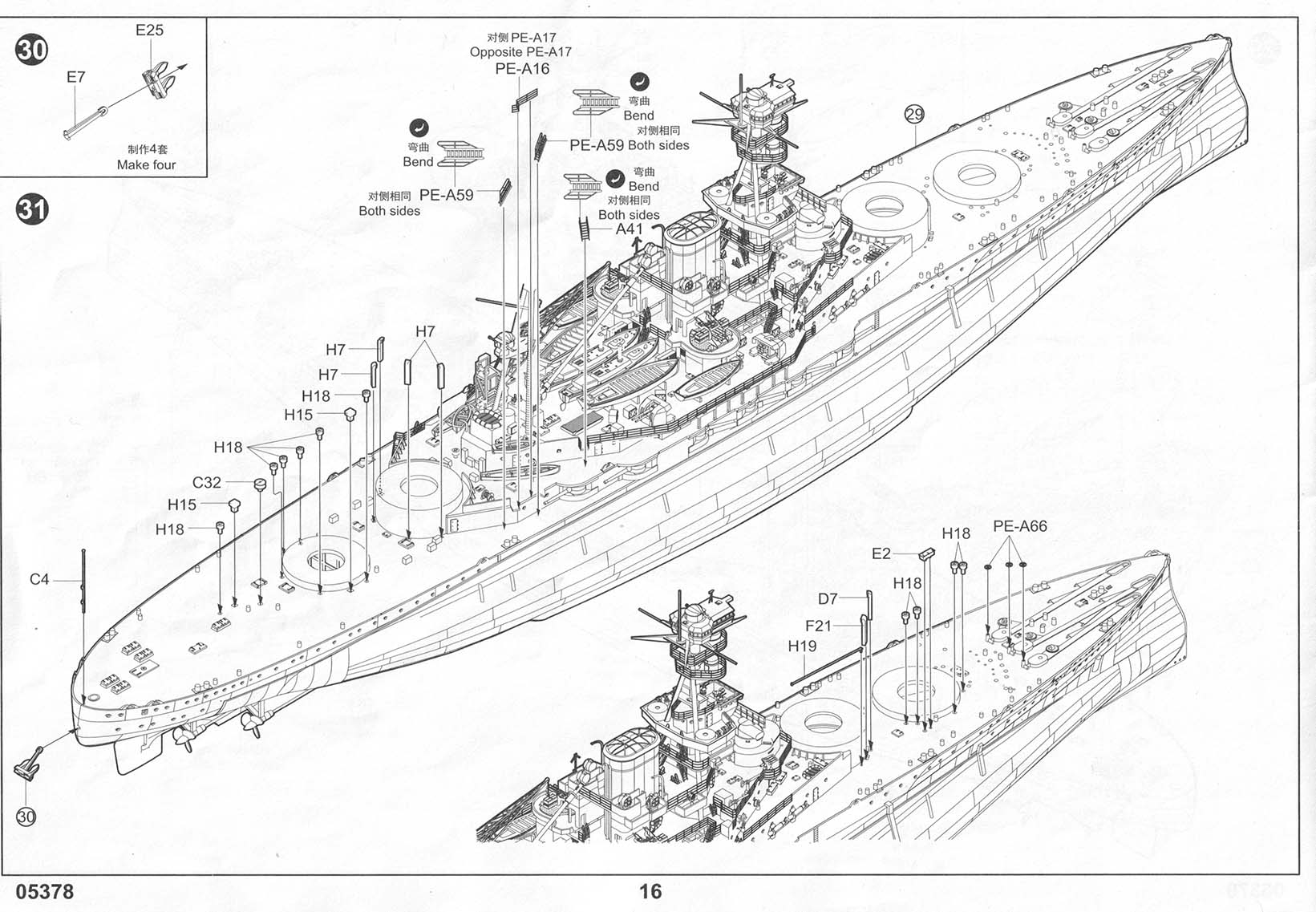
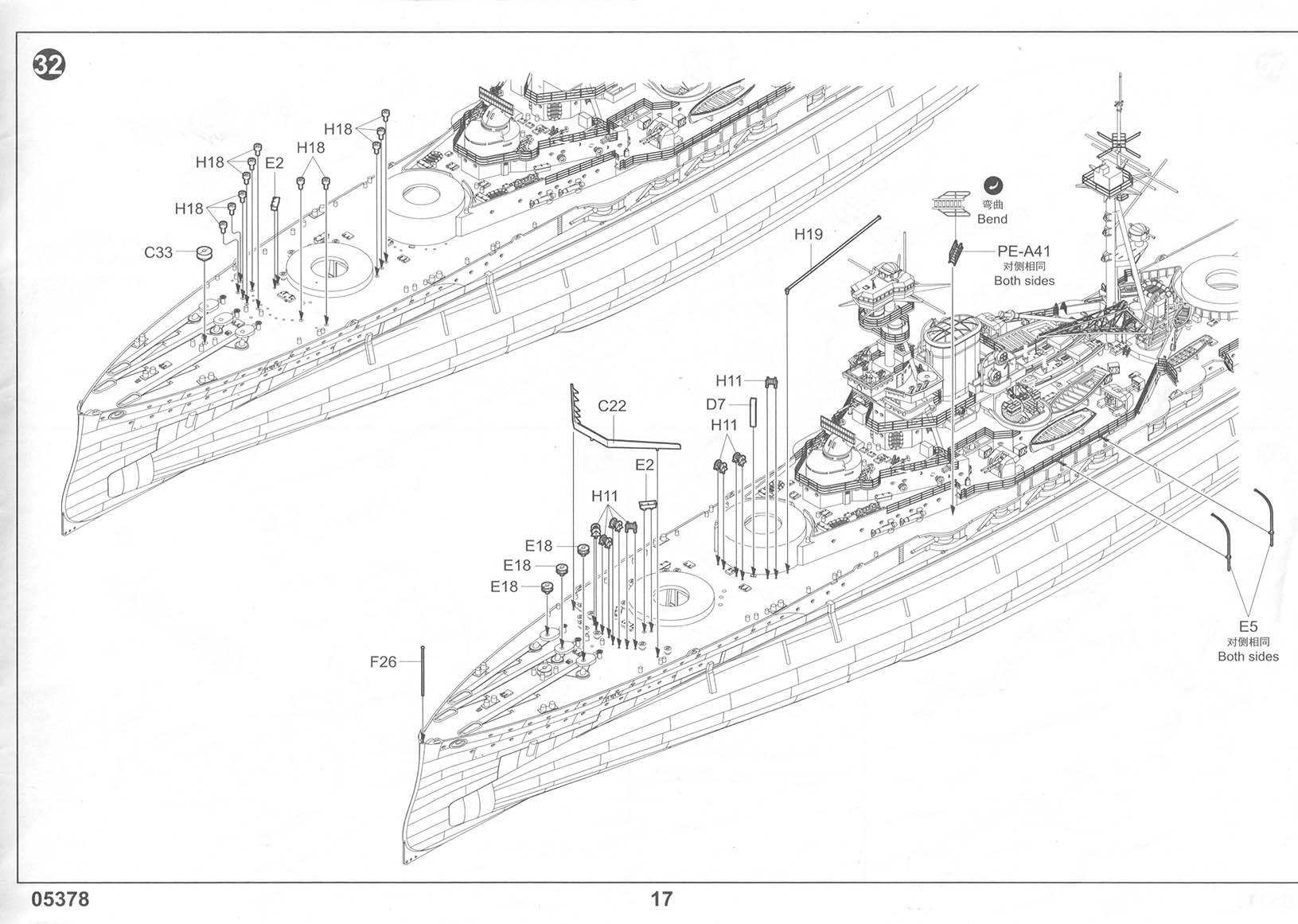
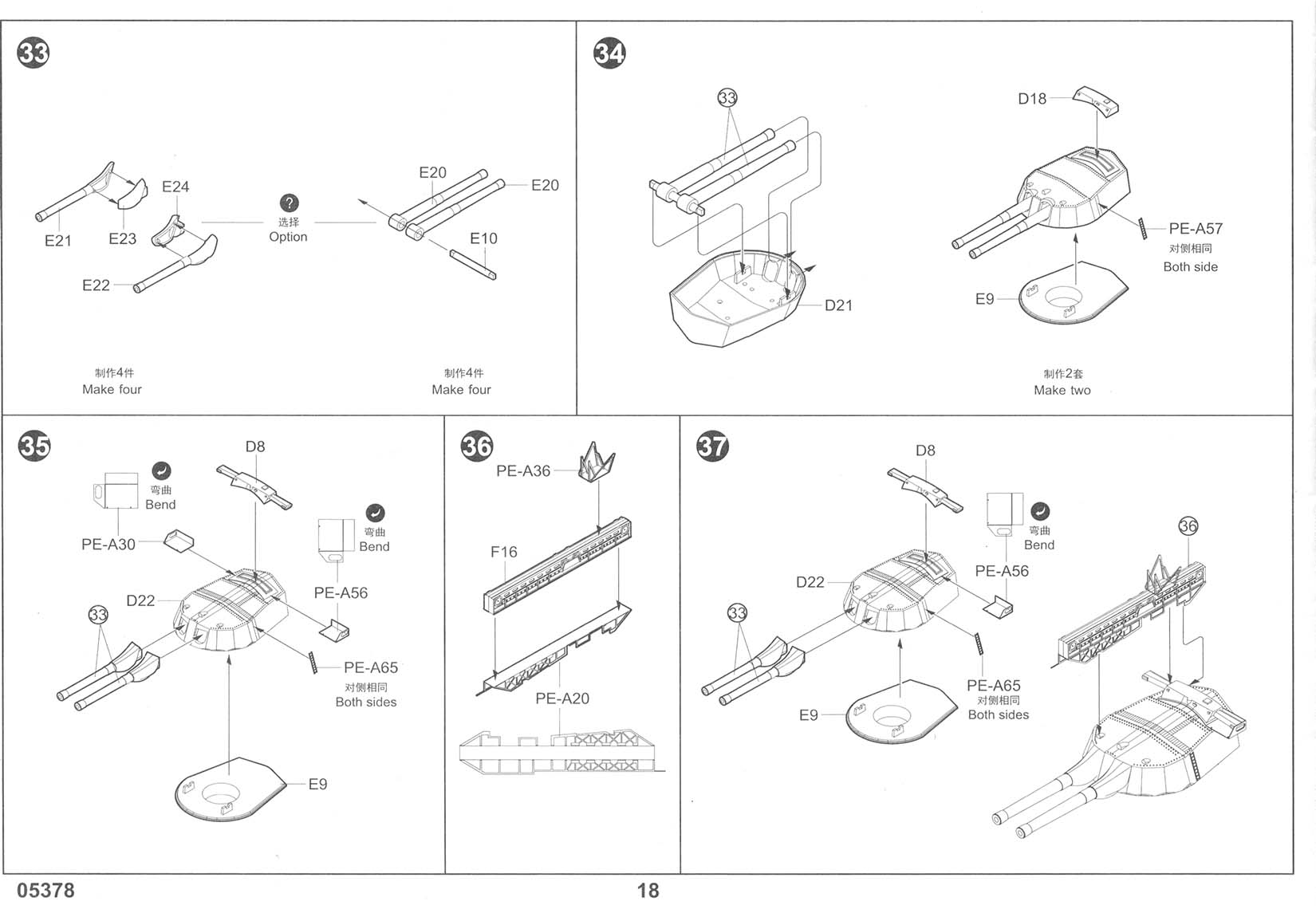
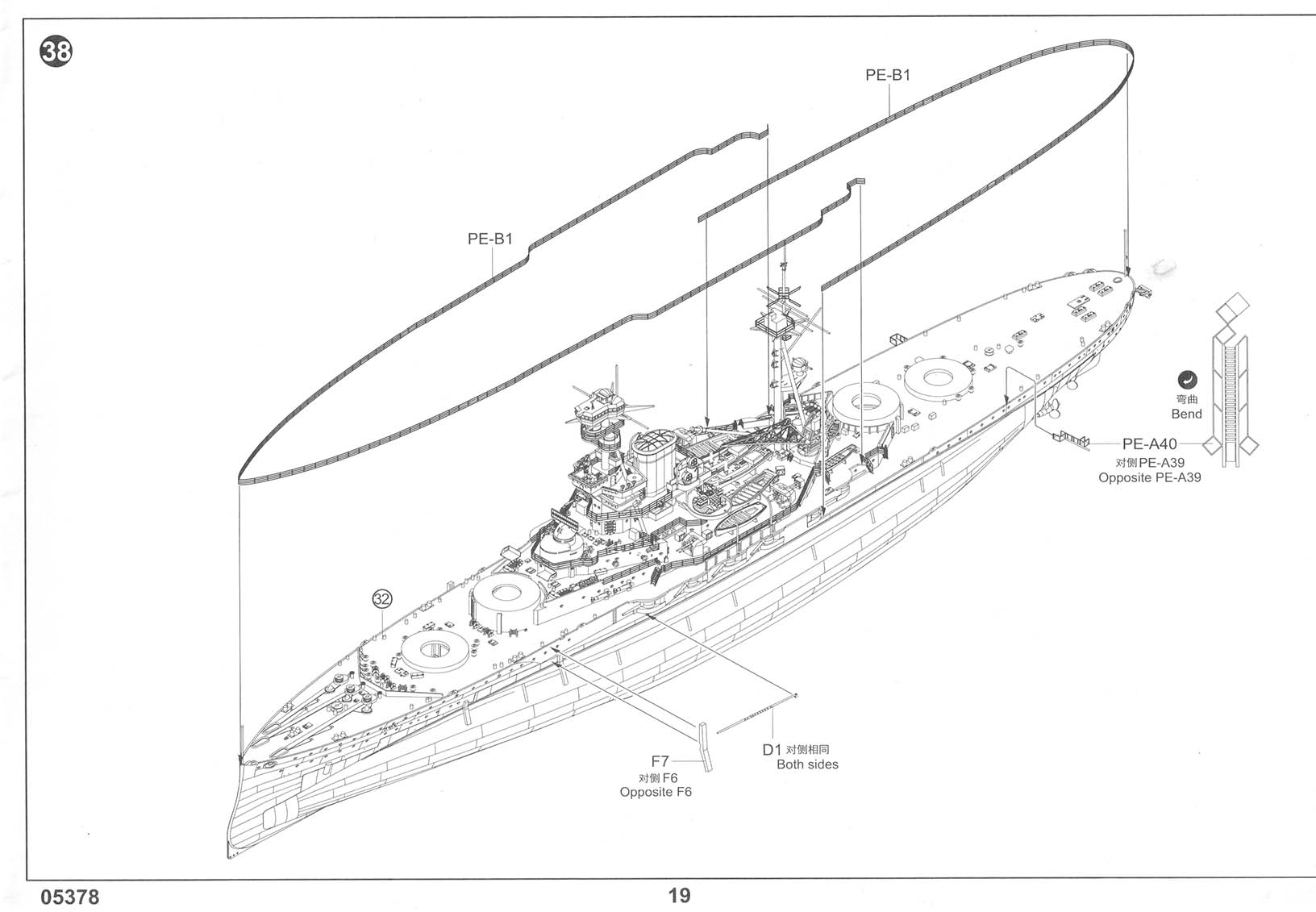
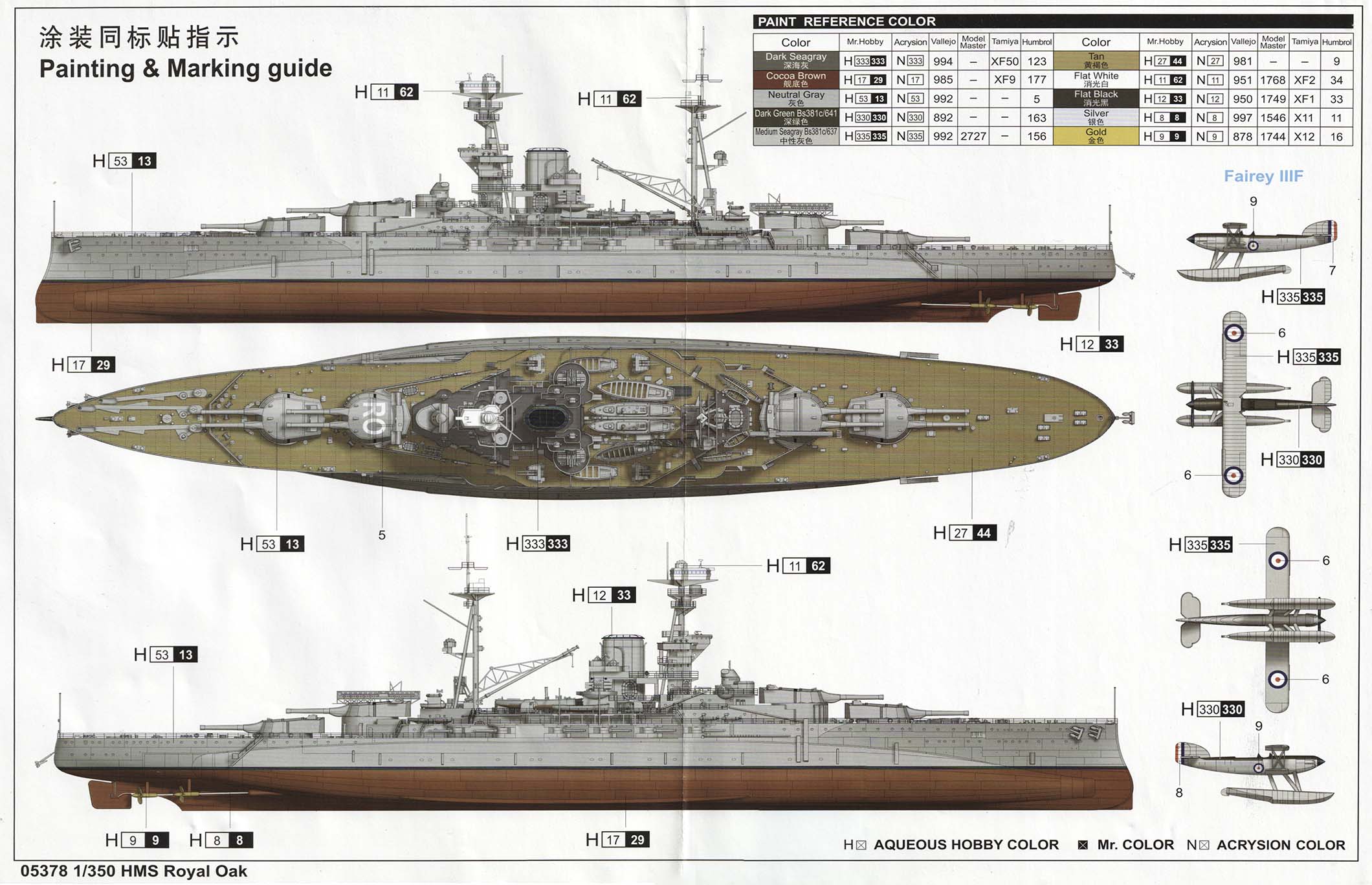
A 20-page instructions booklet is included that should be immediately familiar to anyone who has built a Trumpeter kit before. Exploded view line drawings walk the builder through a 40-step build process. Order of assembly is largely OK - largely sub assemblies are built up in a manner that will help minimize the possibility of damage, but there are a few cases where the order could have been changed for better protection of fragile parts (for example, putting the propellers, shafts and struts on after the main deck pieces instead of before). There is a color profile of the ship included as well, with color call outs for matching paints from a variety of modern manufacturers, including Mr. Hobby, Vallejo, Tamiya and Humbrol, but no data for actual Royal Navy paint is present. Paint at the time of loss was APC507B above the waterline with metal decks either covered in corticine or APC507A (and wood, of course). Royal Oak's anti-fouling was Gray as per Richard Dennis and not the "cocoa brown" called out for by the color sheet. |
|||||||||||||||||||||||||
|
|||||||||||||||||||||||||
| CONCLUSIONS | |||||||||||||||||||||||||
It is nice to finally see a rendition of Royal Oak in 1/350. While not significant in terms of battle effectiveness, her loss was a major event during the Second World War and not at all insignificant. Trumpeter has produced what I would consider a B or B+ effort. It is very clear that they did not work with a subject matter expert and used Kagero Publishing plans as the basis for the kit - mistakes in that set of plans are duplicated on the model. That said, the break down and fit appears to be relatively pain free to build and general accuracy appears to be good other than the boat deck area of the shelter deck. The inclusion of a complete photo-etch set is a positive feature, however having parts that require use of the brass without a plastic alternative is a negative for some. I feel comfortable stating that in terms of engineering and production, this kit finds a decent balance point between those who just want to put parts together and paint them and those who want to up their model to the next level or get as close to total accuracy as they can. I am not a subject matter expert for either Royal Oak or the Royal Navy and lack plans for Royal Oak's hull, so I can't completely comment on the accuracy of this kit, but I do believe that this will be a good foundation for a rendition of the ship that the vast majority will be happy with. References:: |
|||||||||||||||||||||||||